Palace in Szalejów Dolny, Gothic palace in Szalejów Dolny, Poland
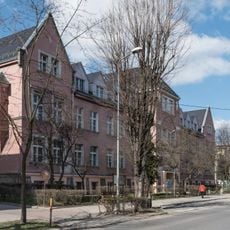
The palace in Szalejów Dolny is a neo-Gothic building erected between 1840 and 1844 to a design by Dresden court architect Ferdinand Martius, with a wing added in 1872. Its main façade features a neo-Gothic central risalit and towers with pointed helmets. From the garden side, a porch is topped by a three-window-wide terrace, and above the middle window a pediment holds a cartouche with the coat of arms of Baron von Münchhausen.
The estate began as a farmstead of the Glaubitz family in the first half of the 14th century. Before 1350 it was bought by Ernst von Pardubitz, the first Archbishop of Prague, and given to the Augustinian monastery in Kłodzko. In 1624 the Jesuits built a manor house here. The present palace was built from 1840 to 1844 by Ernst Freiherr von Münchhausen to a design by Ferdinand Martius, and a wing was added in 1872.
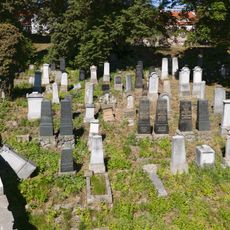
The palace's name comes from the village of Szalejów Dolny, called Niederschwedeldorf in German. Inside, a stained-glass window shows the coats of arms of the Löbbecke, Münchhausen and Reden families, and a fireplace bears the date 1574 with the arms of von Münchhausen and Count Friedrich Wilhelm von Reden. In the park stands the neo-Gothic Münchhausen mausoleum of 1871, restored in 2004, with a German inscription from 1 John 4:16 dated 29.V.16.
The site is located southwest of Kłodzko and can be reached via local roads connecting to the main route DK8. Being situated in a rural area, visitors should plan travel time accordingly.
The dining hall's wooden panelling and a fireplace dated 1574 survived because the building was undamaged in 1945 and was restored in 1970 and 1985. The fireplace carries the arms of von Münchhausen and Count Friedrich Wilhelm von Reden, who owned the estate after 1787.
The community of curious travelers
AroundUs brings together thousands of curated places, local tips, and hidden gems, enriched daily by 94,491 contributors worldwide.