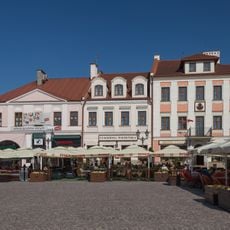
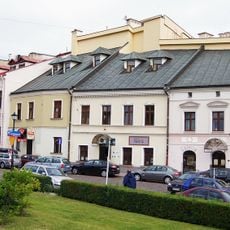
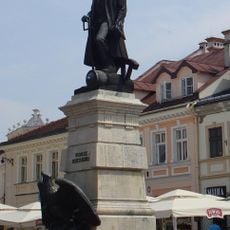
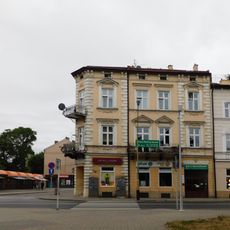
Monument of Gratitude to Red Army, War memorial in Rzeszów, Poland.
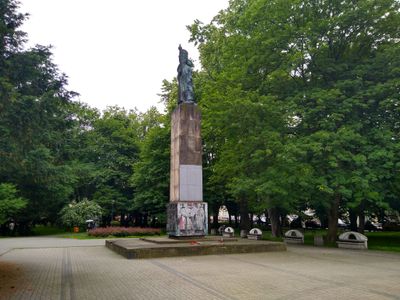
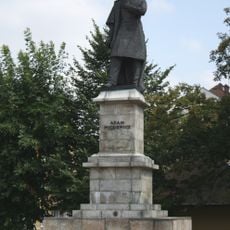
The Monument of Gratitude to the Red Army was a rectangular obelisk about 8.5 metres tall, facing south, topped by a statue of a woman with a child. Four bas-reliefs covered its lower part: Ivan Konev and Karol Świerczewski, two soldiers swearing an oath on a banner, a battle scene, and a worker with a hammer beside a peasant with a sickle. It stood on a granite plinth with an inscription tablet in front, on Plac Ofiar Getta, and was dismantled in September 2026.
The memorial was erected after World War II to honor Soviet soldiers who fought against Nazi forces in Poland. It originated from a period when Soviet influence shaped much of Eastern European politics and culture.
The monument represents a point of debate about how Poland remembers its past and Soviet influence on the nation. Visitors encounter it as a physical symbol that sparks conversations about historical interpretation and collective memory.
The monument no longer exists: it was dismantled in September 2026, so nothing remains at Plac Ofiar Getta. The sculpted decoration of the plinth, the inscription plaque and the soil from battlefields were earmarked for relocation after the city council granted funds in January 2026. Look for the square itself, the site of Rzeszów's only public execution of anti-communist underground soldiers, on 17 June 1946.
The obelisk stood on the site of Rzeszów's only public execution of anti-communist underground soldiers: on 17 June 1946 Bronisław Stęga and Józef Koszela were hanged there, at the former exchange square. The monument was dismantled in September 2026, eight years after the city council voted for its removal.
The community of curious travelers
AroundUs brings together thousands of curated places, local tips, and hidden gems, enriched daily by 94,701 contributors worldwide.