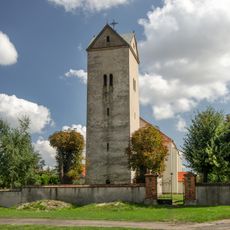
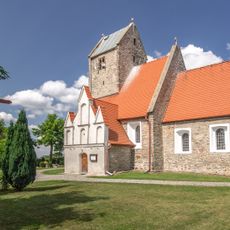
Palace of Oleśnica Mała, Medieval palace in Oleśnica Mała, Poland.
The Palace of Oleśnica Mała is a substantial building in south-western Poland that combines both medieval foundations and baroque architectural elements. The structure blends different building styles that accumulated over time.
The site began as a hunting lodge, possibly a water castle, linked to Duke Bolesław I; from 1193 it was held by the Breslau Sandstift. At the wish of Saint Hedwig, the Knights Templar settled here until their dissolution in 1312, when the estate passed to the Knights Hospitaller, whose commandery was then the largest in Silesia. In 1810 the Prussian state gave it to Ludwig Yorck von Wartenburg.
The building displays features from multiple architectural periods, showing how different rulers left their mark on its appearance over time. Visitors can see these layered styles directly in the structure and decorative elements.
The palace stands in Oleśnica Mała, within a complex that also holds the parish church of St Lawrence and the 1828 Yorck von Wartenburg mausoleum, now a chapel, in the park. The grounds are a 19th-century landscape park, once described in 1678 as an orchard and pheasant garden. Look for the family coats of arms above the courtyard entrances and the mausoleum door.
The 120,000-volume library assembled at the palace was moved to Bad Warmbrunn before 1945; since the war's end it has been dispersed among Polish and Russian libraries. The last German owner, Paul Graf Yorck von Wartenburg, brother of the executed resistance fighter Peter Graf Yorck von Wartenburg, was taken into Sippenhaft and his estate confiscated. A plant-breeding institute was later housed in the palace.
The community of curious travelers
AroundUs brings together thousands of curated places, local tips, and hidden gems, enriched daily by 94,637 contributors worldwide.