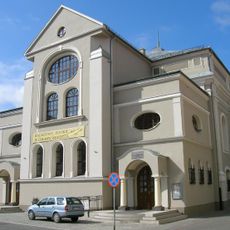
Palace in Leszno, Palace in Leszno, Poland
The Palace in Leszno is a substantial noble residence that displays the architectural style typical of grand estates in western Poland. Its structure consists of multiple wings and a formal arrangement that still defines the character of the location today.
Rafał V Leszczyński began building a Renaissance palace around 1565, resembling a castle with an arcaded courtyard and four corner turrets. After fires in 1656 and 1707, Aleksander Józef Sułkowski had it rebuilt in its present Baroque form between 1750 and 1760 under Karol Marcin Frantz, with interiors directed by Ignacy Graff from 1770 to 1780. In 1843 August Antoni Sułkowski sold the complex to the Prussian state, and from 1845 to 1882 it housed the Royal Prussian Gymnasium.
The residence reflects the tastes and social standing of the families who lived here through its interior finishes and decorative details. The rooms show how the local nobility arranged their living spaces and valued their surroundings.
The palace stands at the corner of ulica Sułkowskiego and ulica Chrobrego in central Leszno. It now houses the district governor's office, the county administration and the regional health fund branch, so access is limited to public areas during office hours. There are no guided tours.
The 25-axis facade's rectangular windows are framed by surrounds added only in 1884, during the building's conversion for the Prussian district and regional courts. The rococo salon upstairs, with Louis XVI motifs and musical emblems hung on ribbon in its panelled boiseries, survives from Ignacy Graff's interior work of 1770–1780.
The community of curious travelers
AroundUs brings together thousands of curated places, local tips, and hidden gems, enriched daily by 94,260 contributors worldwide.