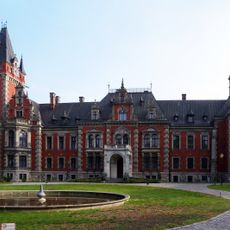
Palace in Bycina, Historical palace in Bycina, Poland.
The Palace in Bycina is a three-storey Baroque building with a mansard roof on an L-shaped plan. Its front portal has two Corinthian columns carrying a frieze topped by a cartouche with the Topór coat of arms of Albert Leopold Paczensky von Tenczin, flanked by pine-cone finials. The south-east facade has fifteen axes, and the Chapel of the Holy Trinity in the south-east corner preserves a late-Baroque vault painting of about 1730 showing the Assumption and the four Evangelists.
The palace was built at the end of the 17th century for Count Albert Leopold Paczensky von Tenczin, chancellor of the principalities of Opole and Ratibor; the garden portal bears the date 1700. After a fire in 1867 the Hohenlohe-Oehringen-Ingelfingen princes rebuilt it. In 1945 Silesia passed to Poland, and the castle church was renovated in 1946, serving as a parish church until 1993.
The palace church, dedicated to the Holy Trinity, was renovated in 1946 and served as the parish church until 1993. In its southeast corner chapel, a late-Baroque vault painting from around 1730 depicts the Assumption of Mary and the four Evangelists. The chapel is inside a building now closed to visitors, so the painting is not on view.
The building is located in Bycina village in Silesian Voivodeship and stands out in its surroundings. Visitors should check access and visiting conditions beforehand since it is a protected monument with restrictions.
The palace is known by three different names across languages: Pałac w Bycinie in Polish, Schloss Bitschin in German, and Palace in Bycina in English. These multilingual names reflect the complex history of the region.
The community of curious travelers
AroundUs brings together thousands of curated places, local tips, and hidden gems, enriched daily by 93,276 contributors worldwide.