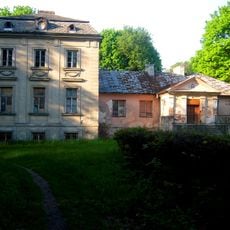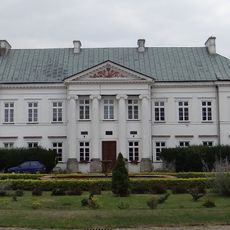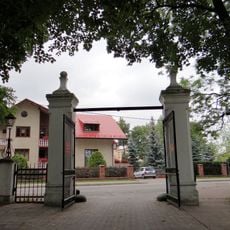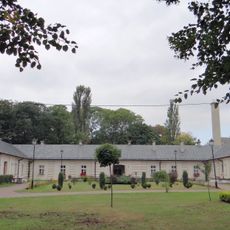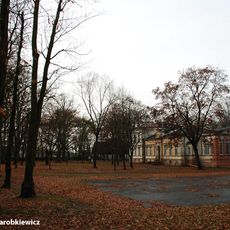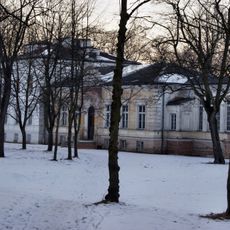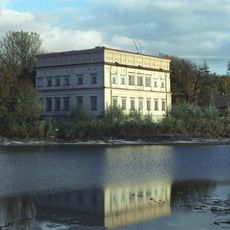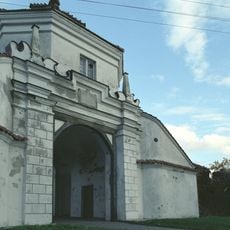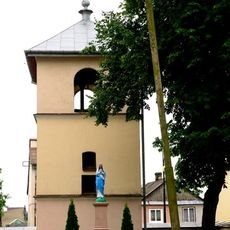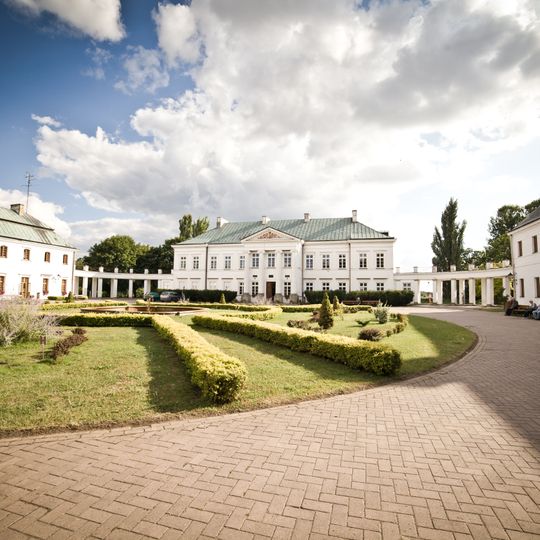
Jabłonowski Palace in Kock, Palace in Kock, Poland.
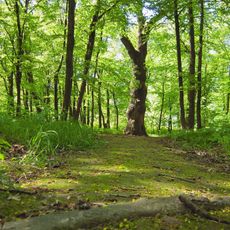
The Jabłonowski Palace is an early 19th-century residence featuring classical architecture with balanced proportions and symmetrical design. The structure sits within landscaped grounds that include garden areas and walking paths throughout the park.
The residence dates to the 16th century as property of the Firlej family. After 1779 Anna Jabłonowska had it rebuilt to a design by Szymon Bogumił Zug; Henryk Marconi simplified it between 1825 and 1832 for Baroness Aleksandra d'Anstett. On 6 October 1939 General Franciszek Kleeberg signed the capitulation of his forces in the palace courtyard. Since 1984 it has housed a state social welfare home.
The palace takes its name from Anna Jabłonowska of the Sapieha family, who after 1777 commissioned Szymon Bogumił Zug to rebuild the residence. In the 1780s she made Kock a centre of learned and cultural life; Emperor Joseph II visited in 1780 and Tsarevich Paul in 1782. Writers Ignacy Krasicki, Adam Naruszewicz, Hugo Kołłątaj, Franciszek Trembecki and Franciszek Karpiński were guests.
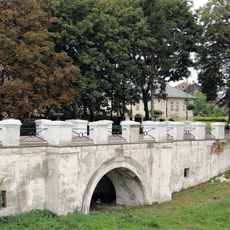
The palace now houses the Maciej Rataj State Social Welfare Home, so interiors are not open to tourists; the building is best viewed from the courtyard and the surrounding grounds. The front courtyard is closed by a low wall with a gate flanked by sphinxes, designed together with the palace by Szymon Bogumił Zug. Kock lies on the road between Lublin and Biała Podlaska, and the palace stands near the town centre.
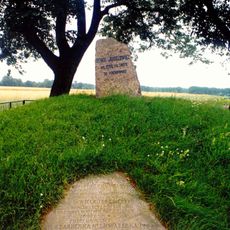
On 6 October 1939, after the Battle of Kock, General Franciszek Kleeberg signed the act of capitulation of his forces in the palace courtyard, handing it to General Gustav Anton von Wietersheim, commander of the XIV Panzer Corps. From 1978 the interiors housed a memorial room to that battle.
The community of curious travelers
AroundUs brings together thousands of curated places, local tips, and hidden gems, enriched daily by 94,459 contributors worldwide.