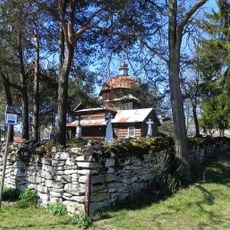
Greek Catholic church in Nowe Brusno
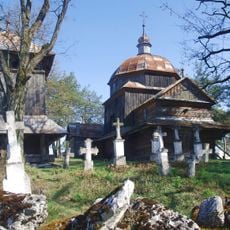
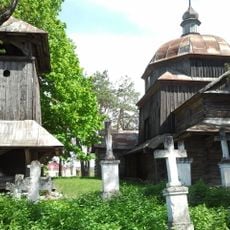
The Greek Catholic church of Saint Paraskeva in Nowe Brusno is a wooden log-built church erected in 1713 by carpenter Stefan Sienko Siematiewski. It has three parts: a nave, a three-sided chancel and a western babinets, whose upper floor held the chapel of Saint Nicholas with an external arcaded gallery. In 1903 a larger western babinets was added, covered by an eight-sided dome that dominates the silhouette.
Built in 1713 by carpenter Stefan Sienko Siematiewski of Płazów for Maurycy Kurdwanowski, starosta of Bełz, it served as a filial Greek Catholic church of the Stare Brusno parish until 1947. The state took it over that year and it fell into ruin; the iconostasis was destroyed in 1962, with fragments kept in museums in Łańcut and Przemyśl. Listed as a monument in 1987, it passed to the Museum of the Borderlands in Lubaczów in 2014 and was restored between 2014 and 2019.
The church is named after Paraskeva of the Balkans and reflects the spiritual roots of the Eastern Christian tradition in this region. Over generations, it has served as a gathering place for the local community during religious celebrations and important holy days.
The church stands in Nowe Brusno, in the Lubaczów area near the Polish-Ukrainian border. It belongs to the Museum of Borderlands in Lubaczów, which took it over in 2014 and carried out the reconstruction of 2014–2019. The wooden building is a stop on the Podkarpackie Wooden Architecture Trail, so it can be combined with other churches of the region.
The church was taken over by the Museum of Borderlands in Lubaczów in 2014, and between 2014 and 2019 it underwent a full conservation. The 1903 rebuild gave the west end an eight-sided dome that dominates the silhouette; the other two domes were re-covered in sheet metal and topped with onion-shaped helms bearing crosses.
The community of curious travelers
AroundUs brings together thousands of curated places, local tips, and hidden gems, enriched daily by 94,589 contributors worldwide.