Palace of Queluz, Royal palace in Queluz, Portugal.
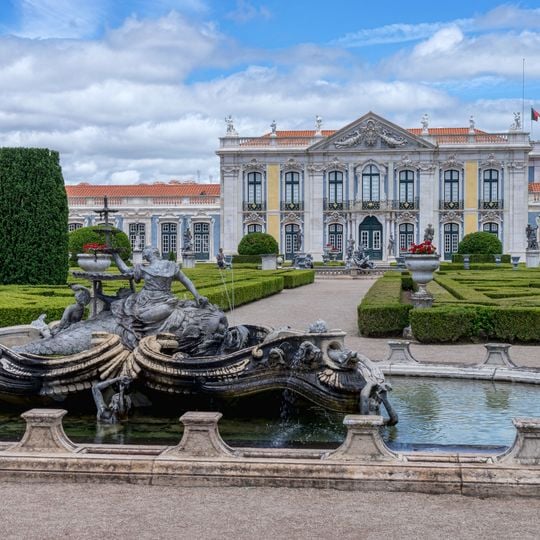
The Palace of Queluz is a long, low Rococo building of light stone with pale yellow panels between white pilasters. Its central section projects forward under a triangular pediment carved with relief figures; the ground floor has seven arched openings and the upper floor seven tall windows with dark balustrades. Stone urns and statues stand above the red-tiled roof, behind clipped green hedges and a paved path.
Construction began in 1747 when architect Mateus Vicente de Oliveira transformed an existing manor into a royal summer residence for Prince Pedro. The project continued for many years, gradually expanding the building into one of Portugal's major palaces.
The palace's name comes from the estate of Queluz, and its chapel holds the tomb of King Pedro III. The gardens, laid out by French designer Jean-Baptiste Robillon, include tile-lined canals where the court once staged water festivities. The Queen Maria I Pavilion now serves as Portugal's official guest house for foreign heads of state.
The palace stands at the end of a town square in Queluz, on the Portuguese Riviera northwest of Lisbon, and can be reached by suburban train from Lisbon's Rossio station. The public facade forms a semicircular cour d'honneur, with the onion-domed chapel closing the southern wing and the former kitchens and servants' quarters in the northern one. Allow time for both the state rooms and the gardens behind the building.
The palace's long, low shape results from the 1755 Lisbon earthquake: when work resumed in 1758, the design was changed to low, long buildings more stable than a single high block. From a distance it looks like linked enfilades rather than one construction. The onion-domed chapel closes the southern quadrant wing.
The community of curious travelers
AroundUs brings together thousands of curated places, local tips, and hidden gems, enriched daily by 94,610 contributors worldwide.