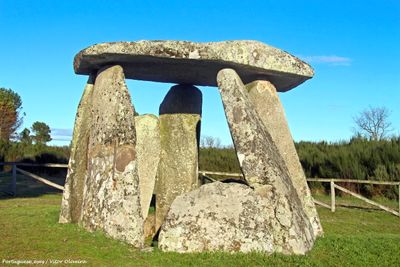
Dólmen da Matança, Neolithic dolmen near Fornos de Algodres, Portugal
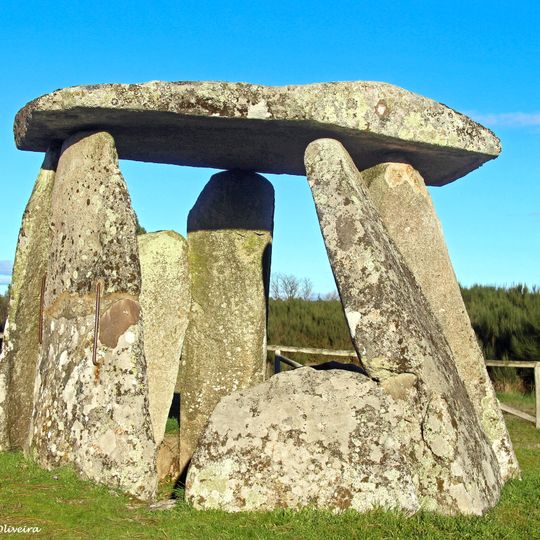
Dólmen da Matança is a Neolithic burial stone structure near Fornos de Algodres built with nine upright stones forming a polygonal chamber topped by a large capstone. Inside, the space held multiple burials and shows the building skills of the people who made it.
Built in the late Neolithic (around 2900–2640 BC), the dolmen was first studied by José Leite de Vasconcelos in September 1896, who recovered artefacts now in the National Museum of Archaeology. Excavated and restored in 1988–1989, it was classified as a Public Interest Property in 1961.
The name Orca da Matança links the monument to the nearby village of Matança, in the parish of the same name. Excavations in 1988–1989 recovered a microlith, two flint arrowheads, two flint axes, a stone bead, sherds of a hemispherical bowl and a jet anthropomorphic idol, now the reference finds for the site.
This site sits next to the road between Matança and Fornos de Algodres and is fairly easy to reach. Visit on drier days since the ground around it can get muddy and slippery.
Two of the nine supporting stones bear carvings: one has an incised serpentine outline, the other pecked surface markings so eroded that their meaning is uncertain. The 1988–1989 excavation found no trace of a lithic passage, so the chamber was entered from the front.
The community of curious travelers
AroundUs brings together thousands of curated places, local tips, and hidden gems, enriched daily by 93,208 contributors worldwide.