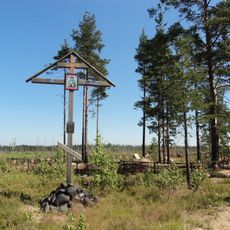
Mannerheim Line, Fortification line in Leningrad Oblast, Russia
The Mannerheim Line is a historic fortification in Leningrad Oblast, Russia, stretching 135 kilometers (84 miles) between the Gulf of Finland and Lake Ladoga and built from reinforced concrete bunkers and artillery positions. The installation uses natural terrain features such as dense forests, many lakes, and granite rock to strengthen its defensive capacity.
Finnish military engineers built 168 fortified positions between 1920 and 1924 to create a strategic barrier against possible Soviet advances. The installations were tested during the Winter War from 1939 to 1940 and proved resilient against Soviet attacks of that period.
The defense network takes its name from Carl Gustaf Emil Mannerheim, a Finnish military commander who drew up the first plans for these fortifications. Several concrete bunkers still stand today and show the military architecture of the interwar period, which visitors can explore at different points along the former border.
Most bunkers lie in forested areas and are reached by unpaved paths, so sturdy shoes and a sense of direction are necessary. The structures are often overgrown or partly ruined, so caution is needed when entering or approaching them.
The first phase, built 1920–1924, produced 168 concrete and reinforced-concrete structures: 114 machine-gun bunkers, 6 artillery positions and one mixed. Cost cutting meant this early concrete was unreinforced and too loosely compressed to resist more than medium artillery. The name itself came from Jorma Gallen-Kallela, son of Mannerheim's former adjutant, who used it while guiding foreign journalists in autumn 1939.
The community of curious travelers
AroundUs brings together thousands of curated places, local tips, and hidden gems, enriched daily by 94,568 contributors worldwide.