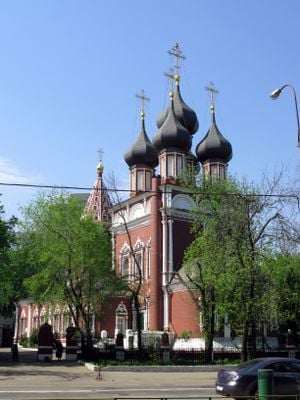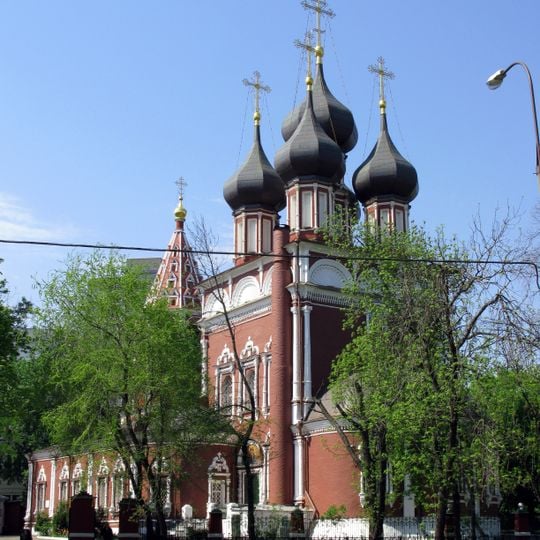
Church of the Deposition of the Robe, Eastern Orthodox church in Donskoy District, Moscow, Russia
This church is a brick religious building designed in Naryshkin Baroque style, a Russian architectural approach from the 17th century. The structure displays the formal arrangements and decorative details typical of this period.
A wooden church was built in 1625 at the spot where Moscow's clergy met the Persian embassy of Shah Abbas I, which brought the Robe of Christ, a relic seized earlier in Georgia, as a gift to Tsar Mikhail Fyodorovich and Patriarch Filaret. The stone church replaced it in 1680 (consecrated 1690; other sources give 1701) in Moscow Baroque style. The Catherine side altar followed in 1701, and in 1886–1889 the refectory was enlarged to designs by architect A. S. Kaminsky.
The feast of the Deposition of the Robe, on 10 July, commemorates the 1625 arrival in Moscow of the Robe of Christ, sent by Shah Abbas I of Persia. It is celebrated only by the Russian Orthodox Church. A silver cross containing a particle of the Robe, given by Patriarch Alexy I in 1951, is displayed on an analogion.
The building stands in Moscow as a federally protected cultural site, which reflects its historical importance. Visitors should remember this is an active place of worship, so respectful conduct is appropriate.
The baroque iconostasis with gilded stucco dates from the mid-18th century, not the 17th. Its side chapels' gilded iconostases were designed by architect A. S. Kaminsky in the 1880s, with icons painted by Ya. I. Ruchkin.
The community of curious travelers
AroundUs brings together thousands of curated places, local tips, and hidden gems, enriched daily by 95,067 contributors worldwide.