Transfiguration Church, Ostrov, Orthodox church in Ostrov, Leninskiy District, Russia.
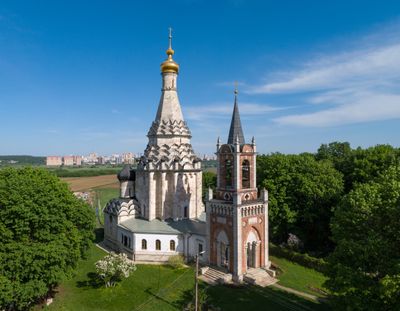
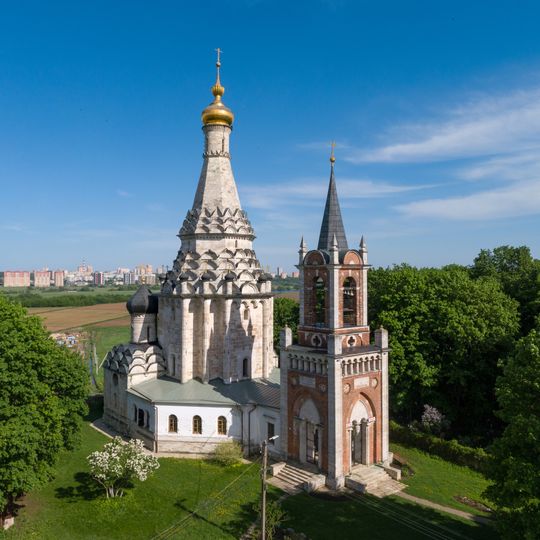
The Church of the Transfiguration in Ostrov is a white limestone tent-roofed church about 40 m tall, built on a cross-shaped plan. An octagon rises from the base to a smooth pyramidal spire crowned by a golden onion dome and cross. Its transitions are covered by 144 kokoshnik arches in four rows, with two identical Pskov-style side chapels under stepped zakomara gables. A covered gallery runs along the north, west and south sides, and a separate neo-Gothic brick bell tower (1830–1838) stands to the right.
Ostrov was a residence of the Moscow princes from the 15th century; in the 18th century it belonged to Alexander Menshikov, then from 1767 to Alexei Orlov, and in the 19th century to the Nikolo-Ugreshsky Monastery. The exact date of the white-stone church is unknown; tradition attributes it to Ivan the Terrible, while Wolfgang Kawelmacher dated it to the late 16th century as a foundation of Boris Godunov, possibly completed in the early 17th century. The neo-Gothic bell tower was added in 1830–1838, and the church was returned to worship in 1992.
Since 1992 the church has again served Orthodox worship and is now a podvorye (metochion) of the Patriarch of Moscow and All Rus. Near it stand two chapels added in the late 1990s: one to St Seraphim of Sarov, and one to St Nicholas the Wonderworker holding a wooden sculpture of the saint shown as Nicholas of Zaraysk, sword in hand and the Transfiguration church in his grasp.
The church stands in the village of Ostrov, Leninsky District, Moscow Oblast, about 40 m tall, and has been used for Orthodox worship again since 1992. It is a metochion of the Patriarch of Moscow and All Russia, so check opening arrangements before travelling. The separate Neo-Gothic bell tower of 1830–1838 stands beside the church and is linked to it by a covered gallery.
The church and the hill it stands on were conceived as a single image of the Transfiguration: three apostles prostrate (the three altar apses), Moses and Elijah flanking Christ (the side drums with cupolas), and Christ himself in the white tent and shining dome. The 144 kokoshniks recall the bright cloud that overshadowed them. This composition is found nowhere else in Russia.
The community of curious travelers
AroundUs brings together thousands of curated places, local tips, and hidden gems, enriched daily by 93,830 contributors worldwide.