Шайтан шәһәрчеге, Medieval fortification in Elabuga, Russia.
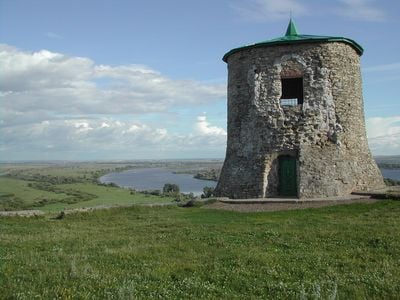
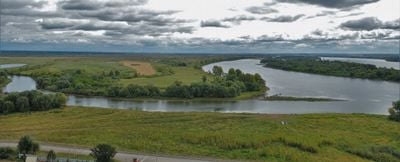
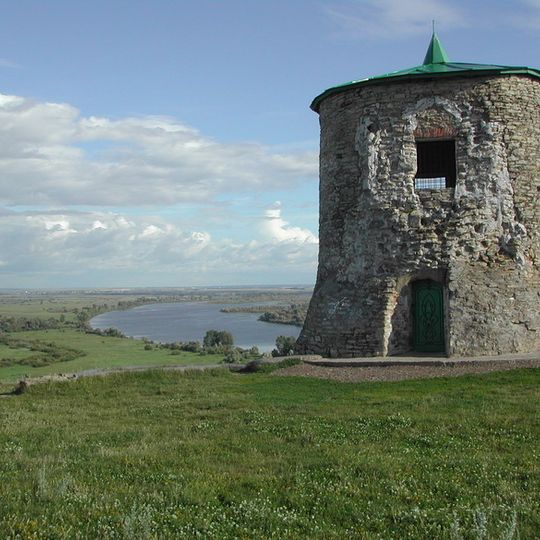
Yelabuga Hillfort stands on the right bank of the Kama River near Yelabuga. Its surviving corner tower is a hollow stone cylinder 7.1 m high with an inner diameter of 5.7 m; the wall thins from 2 m at the base to 0.7 m above, giving the lower half a conical profile. Rough grey and tan stones laid in uneven courses remain on the north side, and the tower is topped by a conical green sheet-metal roof with a spike.
The site began as a tribal refuge in the second half of the 1st millennium AD. In the 10th century a square stone citadel of 400 m² with four towers was built, probably by a Volga Bulgarian prince; its walls between corner towers measured 21 m. The south tower, about 10 m across, served as a lookout over the Kama. In 1844 the tower collapsed; in 1867 Ivan Shishkin, father of the painter, had it rebuilt on the old foundation and covered with iron.
The Tatar name Shaytan shähärchege, "Devil's town", was recorded for the site; Russians also called it Chertovo gorodishche. The square stone building is thought to have been a fortress-mosque, with a triangular half-tower between the corner towers containing a mihrab facing Mecca. Archaeologists found arrowheads on the slope, showing the mosque also served as a small fortress.
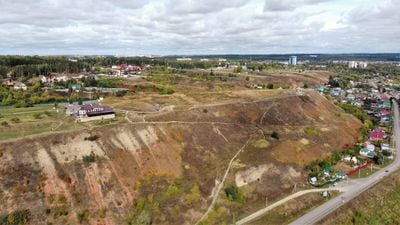
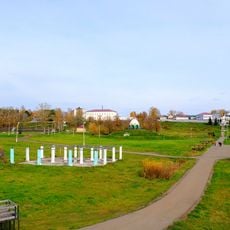
The site sits on an elevated location and is accessible by pathways that lead visitors to the tower. The open setting allows good views of the structure and the surrounding landscape from different angles.
The four rectangular windows in the tower's upper half face the four cardinal directions and date from the 1867 rebuilding, when the top storey was made round instead of the hexagonal form it should have had. The original rough-stone masonry on lime mortar with alabaster survives only on the north side.
The community of curious travelers
AroundUs brings together thousands of curated places, local tips, and hidden gems, enriched daily by 93,921 contributors worldwide.