Shepelyovsky lighthouse, Maritime navigation lighthouse in Gulf of Finland, Russia.
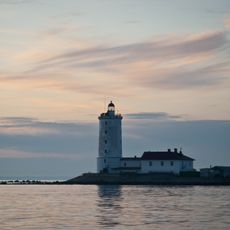
The Shepelyovsky lighthouse is a round brick tower 38 m high, painted in horizontal red and white stripes, topped by a black gallery and lantern. Its focal plane stands at 37 m, and it gives two long flashes every 16 seconds, red or white depending on the sector. It stands on Shepelyovsky Spit on the Goravaldai peninsula, 1.5 km northwest of Shepelyovo. A radio tower about twice its height stands beside it.
The lantern and its optics were made in France in 1910 and mounted on a round brick tower 38 m high. In the winters of 1941–42 and 1943–44 the lighthouse was the starting point of a 71 km ice road across the frozen gulf to the islands of Seskar, Maly and Lavensari. Since 1 November 1987 it has housed a tide gauge synchronised with those at Kronstadt and Lomonosov, and from January 2010 a real-time kinematic positioning station has operated here.
Together with the Stirsudden lighthouse, it marks the entrance to the bay leading to Kronstadt and Saint Petersburg, a passage about 20 km wide but crossed by shoals and currents. The whole approach to the Neva mouth was once called the Kronstadt Bay. The site is under military supervision and not freely accessible.
The tower and its grounds are under military supervision and not freely accessible; the lighthouse stands on Shepelyovsky Cape, about 1.5 km northwest of Shepelyovo. The old radio and observation tower nearby now serves as a viewing tower outside the restricted zone. The light shows two long flashes every 16 seconds, red or white depending on the sector.
In winters 1941–42 and 1943–44 the lighthouse was the starting point of an ice road across the frozen Gulf of Finland to the islands of Seskar, Maly and Lavansaari, 71 km long. Since 1 November 1987 it has also housed a sea-level gauge synchronised with those at Kronstadt and Lomonosov.
The community of curious travelers
AroundUs brings together thousands of curated places, local tips, and hidden gems, enriched daily by 94,537 contributors worldwide.