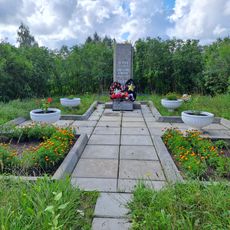
Shum-gora, Medieval burial mound in Podgorye, Russia
Shum-gora is a two-tiered kurgan on the left bank of the Luga River between Podgorye and Zapolye, standing 12–13.5 m high with a base diameter of 70–75 m. Its slopes are faced with limestone slabs set in terraces beneath a 10–20 cm turf layer, and the flat top measures 18 m across. It forms part of an archaeological complex with a hillfort and a settlement.
This mound was built in ancient times as a burial site and remained a mark of prehistoric settlement in the region for centuries. Scholars began systematic study in the early 2000s to learn more about the people buried here and their burial practices.
Local people viewed this mound as a place of spiritual power that drew visitors seeking its healing properties. Beliefs about the therapeutic effects of the sand shaped how communities interacted with and visited the site across generations.
The site sits in a rural area west of Novgorod and remains accessible to researchers and interested visitors drawn to archaeology. It is wise to consider the season, as wet weather can make the terrain muddy and difficult to navigate.
The mound has never been excavated. In 2003 Aleksashin found a boulder on the hill with a monogrammatic inscription, which he compared to Carolingian monograms; on this basis he revived the theory identifying Rurik with Rorik of Dorestad. Georadar surveys in 2002 revealed a chamber of 9×3×3 m at a depth of 14–15 m, oriented east–west, with a wide passage leading to it from the heel stone.
The community of curious travelers
AroundUs brings together thousands of curated places, local tips, and hidden gems, enriched daily by 94,047 contributors worldwide.