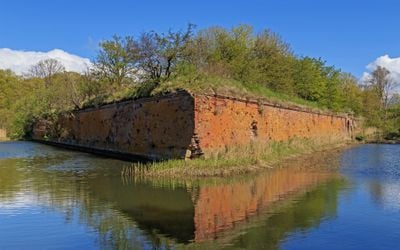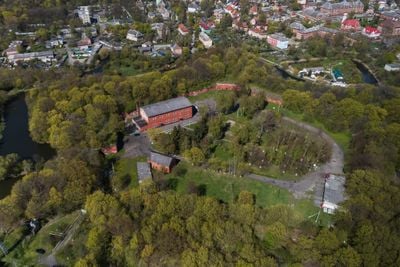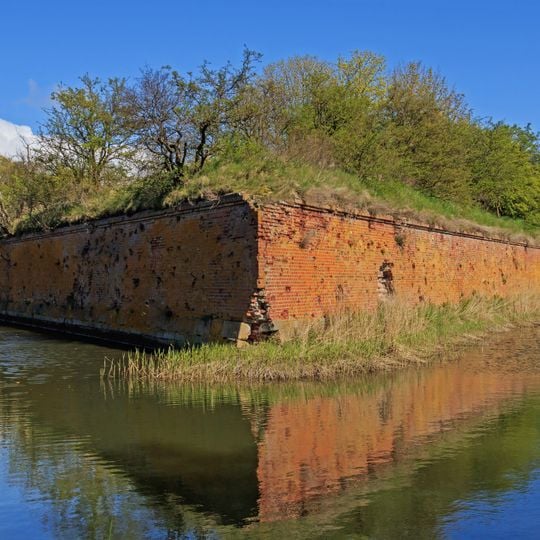
Citadelle Pillau, Star fortress in Baltiysk, Russia.
Citadelle Pillau is a five-sided military fortress positioned at the entrance to Kaliningrad Bay with thick stone walls and defensive bastions at each corner. The structure contains exhibition spaces, storage areas, and an interior courtyard where visitors can grasp the scale and organization of the original fortification.
Swedish king Gustav II Adolf landed at Pillau on 6 July 1626 with a fleet of 37 ships and took the town in three hours; the Swedes then built the pentagonal fortress, with construction led by the Dutch engineer Matthias Wentz from 1632. After the 1635 Truce of Stuhmsdorf, Elector Georg Wilhelm bought the unfinished citadel for 10,000 thalers, taxing every Pillau household three guilders a year to pay the debt. Work was completed by 1670, and the fort was modernised over the following three centuries.
The bastions and ravelins carry names such as König ("king"), Königin ("queen"), Kronprinz ("crown prince"), Storchnest ("stork's nest") and Schinkenschanz ("ham"). A popular tradition held that the statue of Mars moved to the Faulwinkeltor gate showed Gustav II Adolf gazing toward his native Sweden. Since 1999 the citadel has housed a branch of the Baltic Fleet Museum.
Access is available during set hours, and wearing comfortable shoes is wise since you will navigate through multiple levels and stairs. Guided tours in various languages help clarify the layout and purpose of each section when exploring the spaces.
The five bastions carry names: Albrecht, Preußen, König, Königin and Kronprinz, while the ravelins across the moat are Ludwig, Storchnest ("stork's nest"), Faulwinkel, Kronwerk and Schinkenschanz ("ham"). A statue of Mars at the Faulwinkeltor gate was long taken by locals for Gustav II Adolf gazing toward Sweden.
The community of curious travelers
AroundUs brings together thousands of curated places, local tips, and hidden gems, enriched daily by 94,640 contributors worldwide.