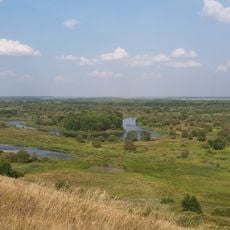
Karaul, Historic estate in Inzhavinsky District, Russia.
Karaul is an estate complex whose main house, built for the Chicherin family by architect S. I. Miller, was a plastered brick-and-wood building in the English cottage style, two to three storeys high, with 38 rooms and over 1,500 square metres of floor space. A stone terrace adjoined it on the south-east side. The house burned down on 2 November 1996; the estate's stone Trinity Church, rebuilt in 1806, stands separately on the grounds.
The village of Karaul likely began in the early 17th century as a watch post on the high bank of the Vorona River, guarding the southern borders of the Russian state. In 1837 the estate was bought by Nikolai Vasilyevich Chicherin, who began building the new manor complex; the family moved into the house in 1849. The main house burned down on 2 November 1996, and restoration work began only in the 2010s.
The stone Trinity Church replaced a wooden one in 1806, funded by owner Iosif Arbenyev. In 1906 its Pokrovsky side altar was removed and the dome painted by Viktor Vasnetsov. A church-parish school for peasant girls opened on the estate in 1901.
The estate lies in the village of Karaul, Inzhavinsky District, on the high bank of the Vorona River. The main house burned down on 2 November 1996; the Trinity Church and the carriage yard survive. Restoration of the church began in 2016, and the main house is being rebuilt in reinforced concrete rather than the original wood and plaster.
Georgy Chicherin was born at Karaul in 1872 while his uncle Vasily was staying there, and spent his childhood and youth on the estate. He later became People's Commissar for Foreign Affairs of Soviet Russia and the USSR. His protection helped place the estate under state guardianship on 17 July 1918.
The community of curious travelers
AroundUs brings together thousands of curated places, local tips, and hidden gems, enriched daily by 94,084 contributors worldwide.