Rumyantsevsky Obelisk, Granite obelisk in Vasileostrovsky District, Russia.
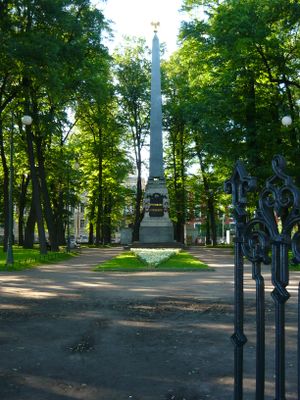
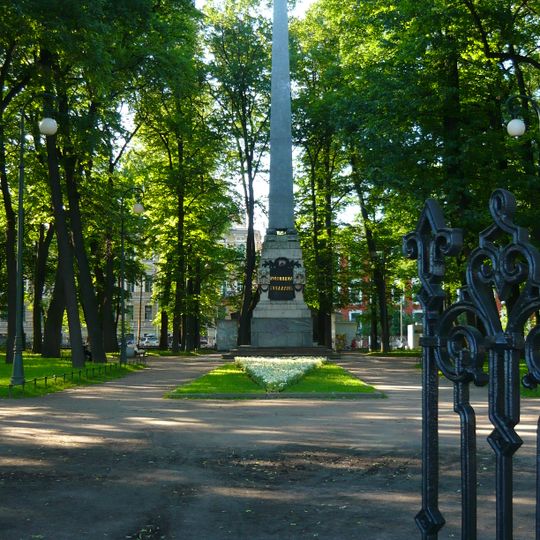
The Rumyantsevsky Obelisk is a 21.3-metre shaft of Serdobolsky granite rising from a pedestal of pink Tivdia and grey Ruskeala marble, set on a three-step stylobate. White Italian marble bas-reliefs of military trophies and bronze garlands decorate the pedestal, whose front bears a black plaque with the gilt inscription "Rumyantsev's victories". The photograph shows the dark grey shaft, the gold lettering and a round reddish-brown medallion below it.
Catherine II conceived the monument in 1795; after her death Paul I decreed it in February 1798, allocating 82,441 rubles. Vincenzo Brenna designed it, and it was erected on Tsaritsyn Meadow in 1799. Moved in 1801 after the Suvorov Monument appeared, it was relocated in 1818 by Carlo Rossi to Vasilyevsky Island, where Rumyantsev had studied at the First Cadet Corps.
The square is named after Rumyantsev, whose name also appears in the gilt inscription on the obelisk's black plaque, written in pre-1918 orthography as "Румянцова побѣдамъ". The surrounding garden was laid out in 1866–1867 at the expense of merchant S. F. Solovyov to a design by Nikolai Kovrigin. From 1939 to 2001 the square bore the name of Ukrainian poet Taras Shevchenko, who had worked at the nearby Academy of Arts.
The monument stands in a public square and remains accessible throughout the day without restrictions. It is easy to reach by public transportation serving Vasilyevsky Island.
Paul I offered Rumyantsev's heirs a palace built at public expense instead of the monument, but they refused. The obelisk was assembled over several months and installed on the Tsaritsyn Meadow in early 1799, before its two later moves.
The community of curious travelers
AroundUs brings together thousands of curated places, local tips, and hidden gems, enriched daily by 93,941 contributors worldwide.