Tanais Archaeological Reserve Museum, Archaeological site in Don River delta, Russia
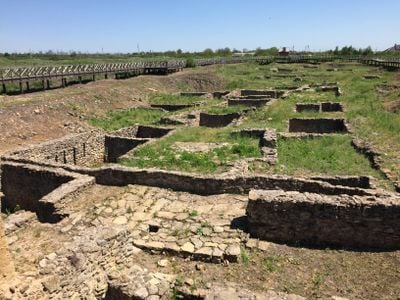
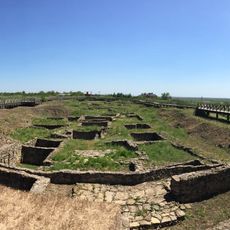
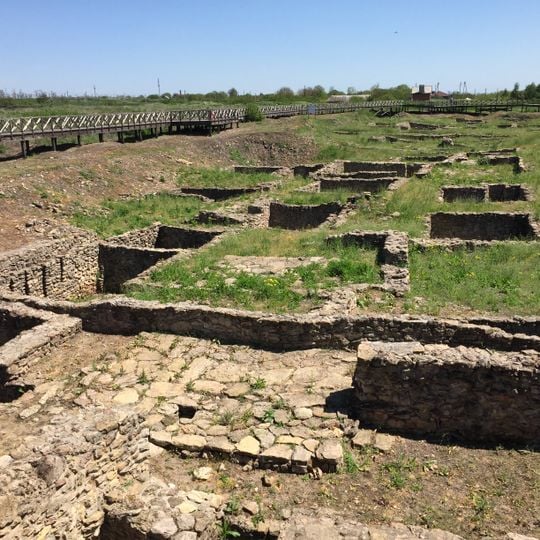
The Tanais Archaeological Reserve Museum protects the excavated stone foundations of the ancient city of Tanais, founded by Greek colonists in the early 3rd century BC at the mouth of the Don River, then called Tanais, where it met the Sea of Azov (Meotida). Rectangular rooms built from rough flat stones in tan, grey and brown lie across uneven ground, with thin grass and weeds growing between the stones. A metal walkway on posts runs along the far edge of the site.
Greek colonists founded Tanais in the early 3rd century BC at the mouth of the Don, and it became an important steppe centre in the 2nd to 3rd century AD. The site was abandoned by the 5th century, identified as Tanais in the early 19th century, and excavated from 1853. In 1955 the Lower-Don expedition led by Dmitry Shelov began systematic study, leading to the reserve museum's creation in 1958 and opening on 1 August 1961.
The city's name comes from the river Tanais, today's Don. Finds in the five exhibition halls include a costume of a Tanais woman of the 4th century AD, recreated from a burial excavated in 1985, alongside Scythian and Sarmatian dress. Since 1993 the excavations have been run jointly with the German Archaeological Institute and the University of Warsaw.
Visitors can walk through the excavated ruins along marked pathways, with guided tours available to explain the discoveries. Wear sturdy shoes as the terrain is uneven and can be muddy depending on recent weather.
This was the farthest northeastern point where ancient Greek civilization reached, making it a rare meeting place of two very different worlds. Artifacts found here carry marks of both Mediterranean and steppe cultures, telling the story of how two worlds traded with each other.
The community of curious travelers
AroundUs brings together thousands of curated places, local tips, and hidden gems, enriched daily by 93,181 contributors worldwide.