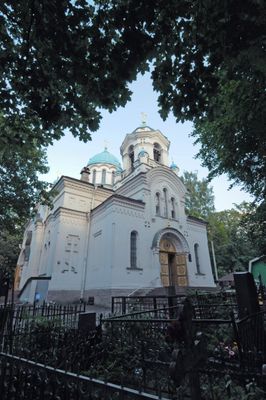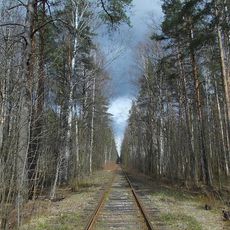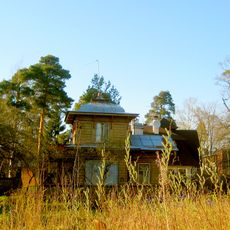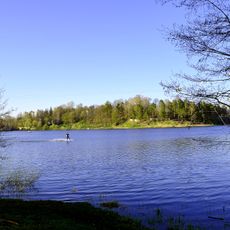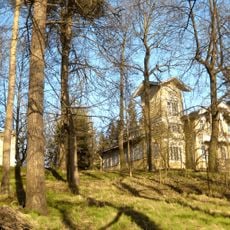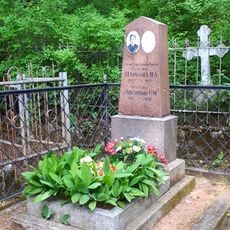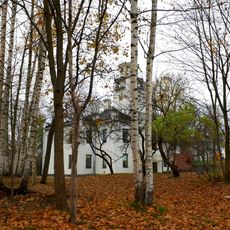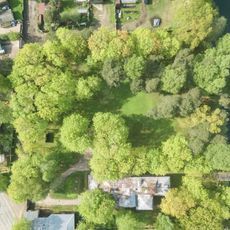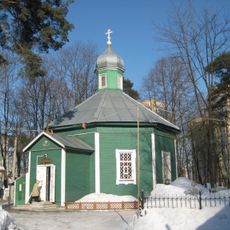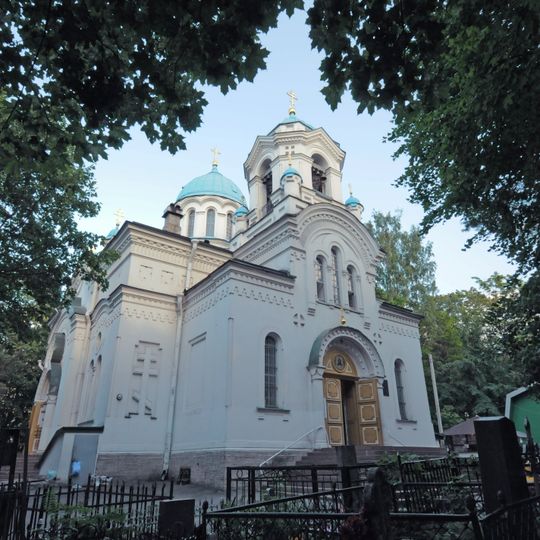
Church of the Holy Mandylion, Orthodox temple in Vyborgsky District, Russia.
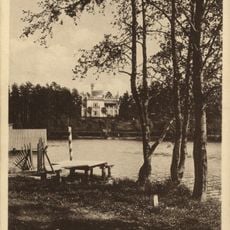
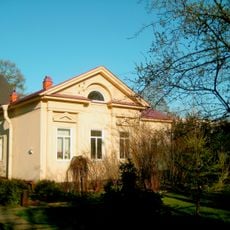
The Church of the Holy Mandylion is a stone Orthodox church in the Russo-Byzantine style, built between 1876 and 1880 to a design by architect K. A. Kuzmin. It stands on a hill by the Bolshoye Suzdal Lake, not in a cemetery, and has three consecrated altars: the main one for the Holy Mandylion, the right for the Protection of the Theotokos, and the left for St Nicholas. A fourth, lower baptismal altar in honour of the Synaxis of the Archangel Michael was consecrated in 2016.
The first wooden church was consecrated on 7 September 1755 in the presence of Empress Elizabeth Petrovna, on land of the Shuvalov family near the Great Suzdal Lake. It burned down after a lightning strike on 31 May 1791; a red-brick chapel was built on the site. In 1792 Countess Ekaterina Shuvalova had a new wooden church erected to a design by Luigi Rusca. The stone church that stands today was founded on 11 July 1876 to a design by Karl Kuzmin and consecrated on 8 September 1880 by Metropolitan Isidore.
The church's name comes from the Mandylion, the cloth believed to bear Christ's imprint. Its main altar is dedicated to the Image of the Saviour Not Made by Hands, celebrated on 29 August. A carved cypress cross with the Passion scenes and a 1678 Trinity icon, donated by peasants who moved from Suzdal province, were kept here; most of these relics are now lost.
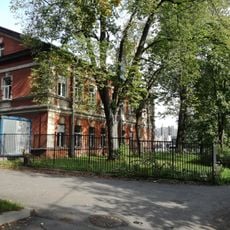
The church stands on a hill by the Bolshoye Suzdalskoye Lake, not in a cemetery; the red-brick chapel built on the site of the burnt 1755 wooden church still stands nearby. The building remained open through the Soviet period, so services continue today. Visitors should dress modestly and avoid photographing worshippers.
The wooden church burned down after a lightning strike on 31 May 1791; a red-brick chapel built on the spot still stands. The present stone church, designed by Karl Kuzmin, was consecrated on 8 September 1880. A 16th-century carved mammoth-ivory icon of the Dormition, donated by parishioners, was moved to the Russian Museum in 1965.
The community of curious travelers
AroundUs brings together thousands of curated places, local tips, and hidden gems, enriched daily by 93,398 contributors worldwide.