وداع السلافية, Memorial sculpture in Moscow, Russia
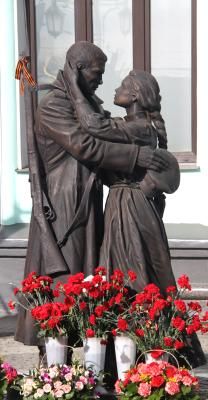
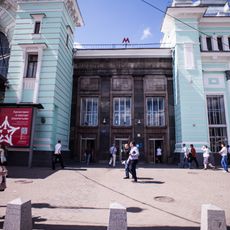
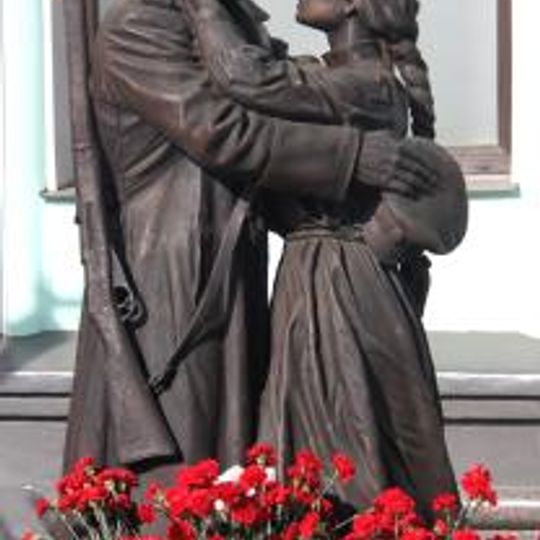
The Slavic Farewell is a bronze sculpture on the square between the Belorussian Station building and the railway tracks in Moscow. It shows a soldier in First World War uniform and a girl embracing him around the neck as she sees him off to the front. The composition stands under two metres high on a bronze ring set in cobblestones, with the words of the march's most common verse inscribed around the ring. Two lamps flank it, bearing shields marked 1914 and 1941.
The monument was initiated by the Russian Military Historical Society with support from Russian Railways and unveiled on 8 May 2014 on the square between the Belorussky station building and the tracks. It honours the march "Farewell of Slavianka", written by military conductor Vasily Agapkin in 1912 during the First Balkan War. On 13 May 2014 two German Mauser 98k rifles were sawn off the "1941" shield on one of the flanking lamps.
The monument takes its name from Vasily Agapkin's march "Farewell of Slavianka", written in 1912 during the First Balkan War. The words of the march's most widespread verse version are inscribed around the bronze ring at the figures' feet. It is dedicated to all Slavic women seeing their relatives off to war.
The monument stands on the square between the Belorussky railway station building and the tracks, on a bronze ring set into the paving stones. The ring carries the words of the march's most widespread verse, and two lamps flank the sculpture, with shields marked 1914 on the left and 1941 on the right. The bronze figures are under 2 metres tall, so the inscriptions are best read up close.
The heraldic shields on the two lamps flanking the sculpture originally carried German Mauser 98k rifles on the "1941" side, mistaken for Mosin rifles; they were sawn off on 13 May 2014, five days after the unveiling.
The community of curious travelers
AroundUs brings together thousands of curated places, local tips, and hidden gems, enriched daily by 93,367 contributors worldwide.