Marid Castle, Military fortress in Dumat al-Jandal, Saudi Arabia
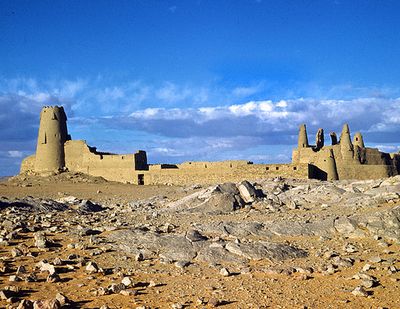
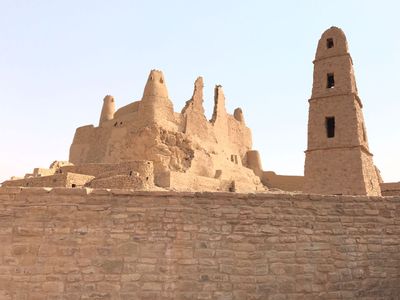
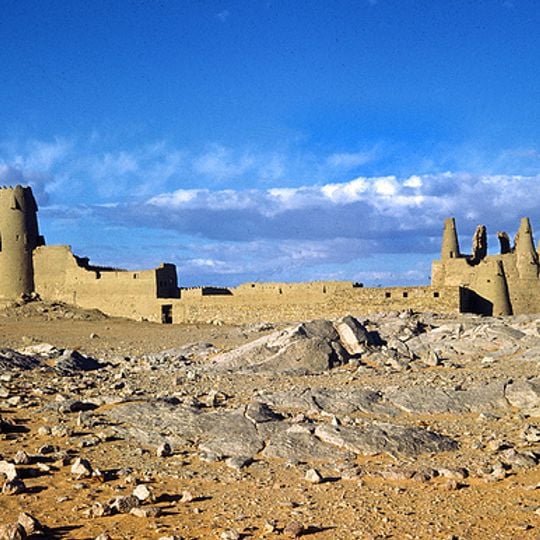
Marid Castle is a fortress of stone and mudbrick, now oval in plan though originally rectangular. Its lower storey is stone and its upper storey mudbrick, with four conical towers about 12 metres high added at different periods. Two wells lie inside, and a large outer stone wall with observation openings and two gates surrounds it.
Excavations uncovered Roman–Nabataean pottery from the 1st–2nd centuries AD, dating the fortress to the 1st century AD. Its earliest written mention is from the 3rd century, when Queen Zenobia of Palmyra besieged Dumat al-Jandal and Tayma but failed to take Marid. In 633 CE Khalid ibn al-Walid annexed the town to the Islamic empire. In 1853 Talal Ibn Rashid damaged the castle with two cannons, and in 1909 Nawwaf Ibn Sha'lan besieged it for ten months before taking it from the Rashids.
The name Marid means "rebellious," a reference to the castle's defiance of attackers, as the medieval geographer Yaqut al-Hamawi recorded. Queen Zenobia of Palmyra, unable to take it in the third century, is said to have coined the phrase "Marid has rebelled, and Ablaq has glorified." Today the castle is visited alongside the nearby Umar ibn al-Khattab Mosque and the old market of Dumat al-Jandal.
The climb to the top follows a winding stair of about 1,000 steps and takes roughly 30 minutes. The castle has two gates, one to the south and one to the north beside a tower, and the outer wall has matching south and north gates. Sturdy shoes help on the uneven stone.
The name Marid means "rebellious", taken from the castle's defiance of besiegers, as the geographer Yaqut al-Hamawi recorded. Queen Zenobia of Palmyra, unable to take it in the third century, is said to have coined the phrase "Marid has rebelled, and Ablaq has glorified", Ablaq being the fortress at Tayma.
The community of curious travelers
AroundUs brings together thousands of curated places, local tips, and hidden gems, enriched daily by 93,361 contributors worldwide.