Hultaby slott, Medieval castle ruins in Vetlanda Municipality, Sweden
Hultaby slott is a ruined medieval castle on a promontory on the south shore of Lake Norrasjön, at the mouth of the Emån River. The site comprises a castle building, an inner and an outer bailey, and about 19 house foundations. The inner bailey is enclosed by a partly collapsed, grass-covered 5-metre breastwork wall with two openings; a monumental slate staircase leads to the large opening.
Built in the second half of the 13th century and rebuilt in the early 14th, the castle is first documented in 1353, when Erengisle Sunesson wrote a letter from Hultaby ö. It was probably burned in the 1360s during the feuds between Magnus Eriksson and Albrekt av Mecklenburg. In 1392 the already ruined castle was bequeathed to Växjö Cathedral, and in 1510 it passed to the Bishop of Linköping.
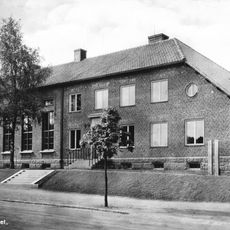
The name Hultaby ö appears in a letter Erengisle Sunesson wrote here in 1353, and in 1392 he willed the castle to Växjö Cathedral. After Gustav Vasa reclaimed the estates, Erik XIV gave them to Erik Leijonhufvud, who turned Hultaby into a säteri manor; the Falkenberg family held it from 1650 and the Estners from 1852. The present main building dates from 1868.
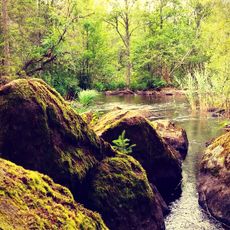
The ruin lies on a headland on the south shore of Norrasjön, at the mouth of the Emån. The inner courtyard is enclosed by a partly collapsed rampart wall about 5 m high, now overgrown with grass, with two openings; the large one is reached by the reconstructed slate stair. Ground is uneven, so wear sturdy shoes.
The outer stone staircase of schist leading to the inner courtyard was reconstructed in 1934–1935, when excavations uncovered remains of the original steps. The digs also dated the castle to 1250–1350.
The community of curious travelers
AroundUs brings together thousands of curated places, local tips, and hidden gems, enriched daily by 94,705 contributors worldwide.