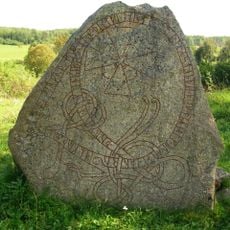
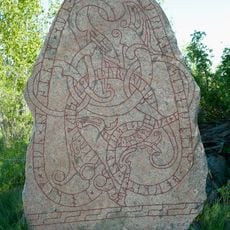
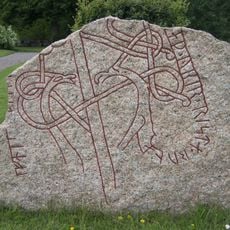
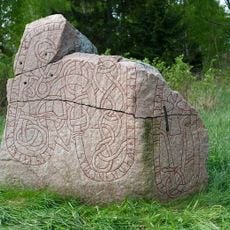
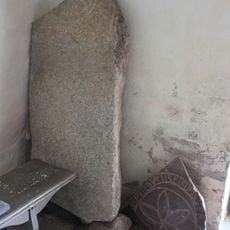
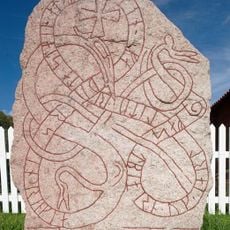
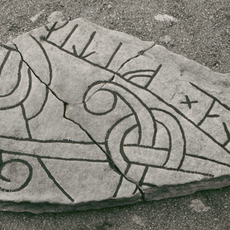
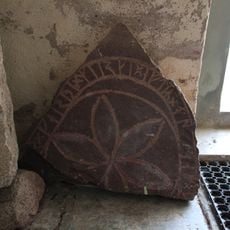
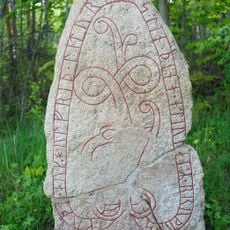
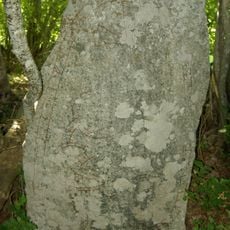
Möjbro Runestone, Norse runestone in Uppsala Municipality, Sweden.
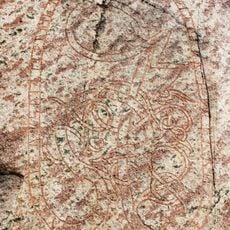
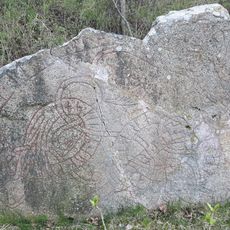
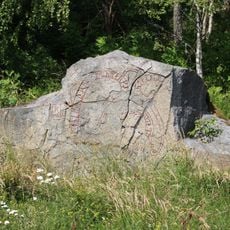
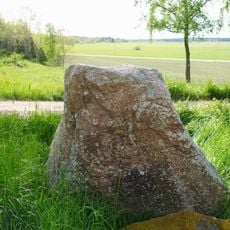
The Möjbro Runestone is a granite stone 2.46 metres tall, designated U 877, inscribed in Proto-Norse with the Elder Futhark. Its shallow carving shows a rider on a horse with two dogs, read from right to left and bottom to top. The runes are mirrored, and the lower line is centred while the upper line's four leftmost characters are cramped together.
The stone was created between 400 and 550 AD during an early period of runestone tradition in Scandinavia. It was later moved to Stockholm for protection from weathering and to make it accessible for study.
The rider with two dogs was long read as a battle scene; the dogs were only identified by Sven B. F. Jansson in 1952, shifting the emphasis toward a man skilled in hunting as well as war. The shallow carving means the painted filling can mislead: in unpainted light the shield and hands fade, while the rider's body and draped garment emerge.
The artifact is now housed at the Swedish History Museum in Stockholm where it is preserved under controlled conditions. Visitors should note that the carved details are best viewed up close, and natural lighting helps reveal the surface texture and inscriptions.
The runes on this stone follow an unusual path running from bottom to top and right to left in an S-shaped pattern. This unconventional layout sets it apart from later runestone traditions and shows the experimental nature of early Nordic writing.
The community of curious travelers
AroundUs brings together thousands of curated places, local tips, and hidden gems, enriched daily by 94,550 contributors worldwide.