Gråborg, Medieval castle ruins in Öland, Sweden
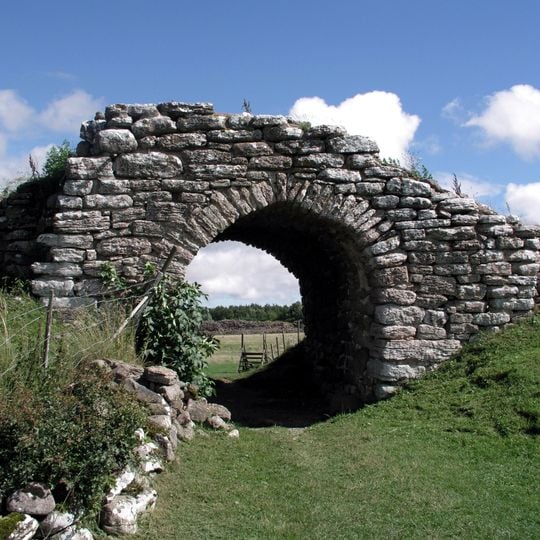
Gråborg is an elliptical hillfort ruin on Öland, about 210 by 160 metres, enclosed by a ring wall roughly 4 metres high built of irregular grey stones set partly in mortar. Three openings pierce the wall, one once topped by a medieval tower. The interior is now grass-covered, and no house foundations remain.
Gråborg's oldest parts likely date from the 5th or 6th century, and the ring wall reached its present size in the 12th century after being expanded in stages. During the Middle Ages it was probably used as a protected marketplace, and one of its three openings was given a tower superstructure. Legend links the fort to the anti-king Burislev Sverkersson, who grew up here with his half-sister Sofia of Minsk.
The hillfort's older names, "Backaborg" and "Borg", survive in the nearby village of Borg, owned by the Royal Academy of Letters since 1945. Legend ties Gråborg to the anti-king Burislev Sverkersson, who is said to have grown up here with his half-sister Sofia of Minsk.
The interior of the fort is grass-covered and no building foundations survive, so the rampart itself is the main thing to walk. The wall is about 4 m high and partly mortared on the outside; the ground inside rises in a bank of earth through the central opening. The ruins of St. Knut's Chapel lie just next to Gråborg, where only the western gable and the triumphal arch remain.
The fort was long called Backaborg or simply Borg, and legend ties it to the anti-king Burislev Sverkersson, said to have grown up here with his half-sister Sofia of Minsk. No house foundations survive inside, as later ploughing erased them.
The community of curious travelers
AroundUs brings together thousands of curated places, local tips, and hidden gems, enriched daily by 94,344 contributors worldwide.