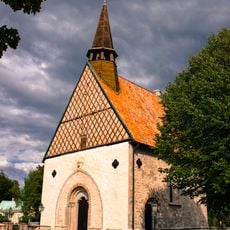
Gotland Runic Inscription 181, Viking Age runic inscription at Sanda Church, Sweden
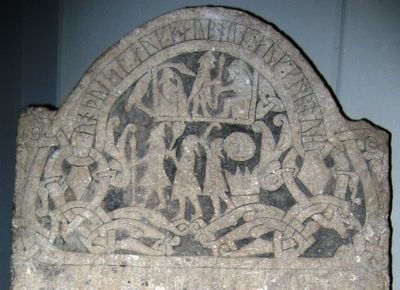
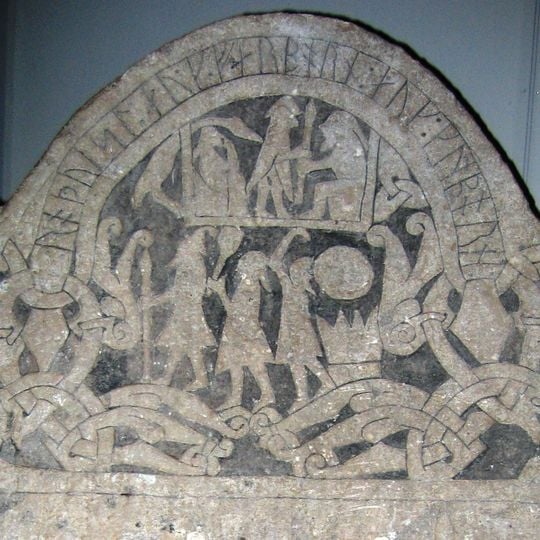
Gotland Runic Inscription 181 is a Viking Age stone carving written in younger futhark runes, displaying depictions of three Norse gods with their characteristic weapons and attire. The artwork exhibits the Ringerike style, a recognized design of this period featuring detailed carved work.
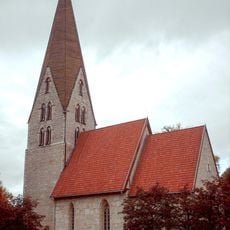
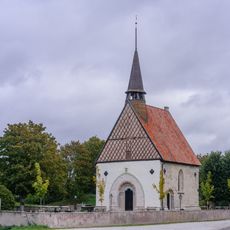
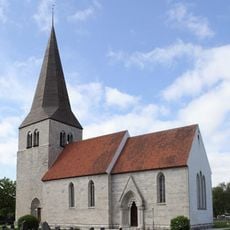
The slab is one of Gotland's picture grave-cists, in use on the island between about 700 and 1100 AD. Its carving is dated to 1000–1100 by the runic band running along a double-headed serpent. Found in the churchyard of Sanda Church in 1863, it is now kept at Gotlands Fornsal in Visby.
The runic band names three men: Rodvisl, Farbjörn and Gunnbjörn. Björn means "bear", Gunnbjörn "battle bear" and Farbjörn possibly "far-travelling bear". The stone was found at Sanda churchyard and is now kept at Gotlands Fornsal in Visby, not in Stockholm.
The stone is housed in the Swedish Museum of National Antiquities and is accessible to visitors during regular opening hours. It is advisable to check in advance whether the museum is open and to allow time for viewing the detailed carvings.
The stone was found in Sanda churchyard in 1863 and is now in Gotlands Fornsal in Visby, not in Stockholm as older catalogues state. It is about 90 cm wide, with a carved field roughly 70 cm high, and the inscription names Rodvisl, Farbjörn and Gunnbjörn.
The community of curious travelers
AroundUs brings together thousands of curated places, local tips, and hidden gems, enriched daily by 94,662 contributors worldwide.