Tullgarn Palace, Royal palace in Södermanland, Sweden
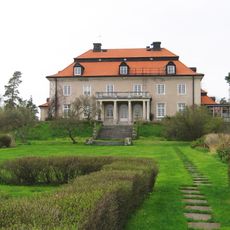
Tullgarn Palace is a three-storey building with a pinkish-orange upper facade and a pale grey ground floor, its central section topped by a triangular pediment. A dark clock tower with a green dome and thin spire rises from the roof, and rows of tall rectangular windows run behind a balustrade. Two eight-metre-wide wings extend from the 43-metre main block, forming an open courtyard facing Tullgarnsviken.
The first castle here, Stureborgen, was built around 1600 in Renaissance style on a rocky point in Tullgarnsviken. In 1719 it was demolished, and Privy Councillor Magnus Julius De la Gardie, who had inherited the estate in 1713, used his fortune from his marriage to Hedvig Catharina Lillie to commission a new palace. Architect Joseph Gabriel Destain and Stockholm craftsmen built it between 1720 and 1727. In 1772 the crown acquired Tullgarn and made it a royal residence.
The name Tullgarn comes from tylle, a pine grove, and garn, a narrow inlet, and has nothing to do with customs. Duke Fredrik Adolf lived here from 1778 to 1793 with his lover Sophie Hagman; stories from those years survive as the Tullgarn memories. The breakfast room is fitted out like a south German Bierstube, recalling Queen Victoria's origins in Baden.
The palace is located less than an hour from Stockholm and offers parking facilities and a cafe for visitors during opening hours. The site is easily accessible from major roads and provides ample space for exploring the grounds.
In 1924 the Ethiopian crown prince Ras Tafari, later Emperor Haile Selassie, stayed at Tullgarn during a tour of Europe. The vestibule walls are covered in hand-painted Dutch tiles, and the breakfast room is fitted out like a south German Bierstube, recalling Queen Victoria's origins in Baden.
The community of curious travelers
AroundUs brings together thousands of curated places, local tips, and hidden gems, enriched daily by 93,489 contributors worldwide.