Rosersberg Palace, Royal palace in Rosersberg, Sigtuna Municipality, Sweden.
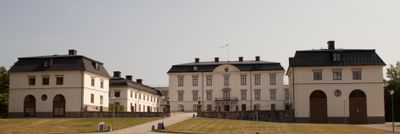
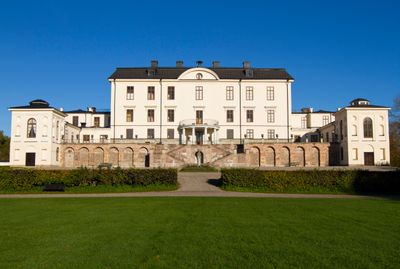
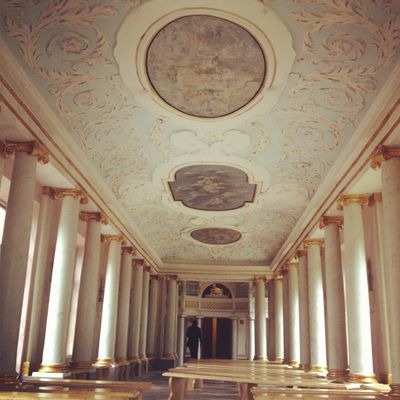
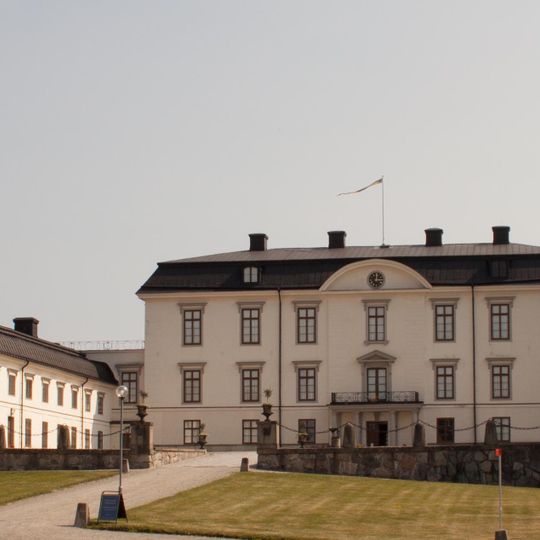
Rosersberg Palace is a three-storey, pale yellow building with a dark hipped roof on a low stone base, its central bay marked by a clock, balcony and domed pediment. Wings extend to either side above a raised terrace on a round-arched stone arcade reached by a double stairway. The main block was built 1634–1638; Nicodemus Tessin the Younger later replaced its gables and roof and added the wings and colonnaded gallery.
Gabriel Bengtsson Oxenstierna built the palace in 1634–1638 and named it after his mother of the Tre Rosor family. His son Bengt had Nicodemus Tessin the Younger modernise it in the Baroque style, and in 1762 the state gave it to Duke Charles, later Charles XIII. Gustaf af Sillén led the 1797 interiors, and Charles XIV John and Desideria were the last royals to live here.
The palace name comes from Gabriel Bengtsson Oxenstierna's mother, of the Tre Rosor (Three Roses) family. The chapel in the lakeside wing, completed in 1695, was used by Queen Desideria for Catholic services though the court was Lutheran. Since 2004 the palace has been open for guided tours, and tournaments are held near it in late July.
The main building is shown only on guided tours, while the wings and grounds can be explored freely. The park retains the avenues and a 600-metre pond from Tessin the Younger's late 17th-century French Baroque garden, plus an English garden with winding paths laid out around 1800. A café and bed and breakfast opened in the palace complex in summer 2008.
The bedchamber of Karl XIV Johan preserves original furnishings from the early 1800s and stands as one of Sweden's most complete period rooms. These spaces show how the king actually lived.
The community of curious travelers
AroundUs brings together thousands of curated places, local tips, and hidden gems, enriched daily by 93,583 contributors worldwide.