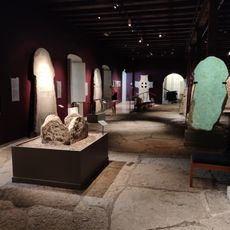
Burmeisterska huset, 17th-century merchant house in Visby, Sweden
Burmeisterska huset is a timber-framed merchant house built in 1652–1654 for Hans Burmeister, with a wing added in the 1670s. Its upper hall has walls and ceiling entirely covered with painted pastoral landscapes, and the ground-floor stuga also retains interior paintings.
Hans Burmeister, a merchant from Lübeck, built the house in 1652–1654; the wing was probably added in the 1670s. The Burmeister family kept it until 1851, when Johanna Fredrika Burmeister died and the property was sold. In 1895 Colonel Gustaf Björlin bought it and began restoring it; the city of Visby acquired it in 1904 with public funds and restored it to a 17th-century appearance.
The painted hall upstairs and the ground-floor stuga show pastoral landscapes covering entire walls and ceiling. Emil Nordström filled gaps in these paintings during the 1904 restoration, when the city returned the house to a 17th-century appearance. From summer 1906 the Gotland Tourist Association ran it as museum, tourist office, souvenir shop and restaurant.
The building sits between Strandgatan and Donners platz in Visby's historic center, making it easy to reach on foot. As a preserved historical structure, the interior may have narrow passages and uneven floors typical of old buildings.
This building represents one of Sweden's most complete surviving examples of a 17th-century Hanseatic merchant residence, with its original design largely unchanged. The house preserves details that show how successful traders lived and conducted business during that era.
The community of curious travelers
AroundUs brings together thousands of curated places, local tips, and hidden gems, enriched daily by 94,515 contributors worldwide.