Hagaparkens pelouse, English landscape park in Solna, Sweden
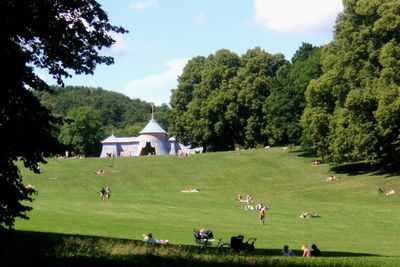
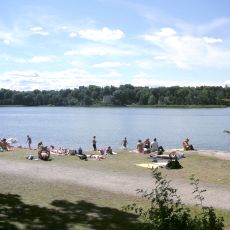
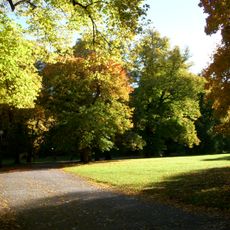
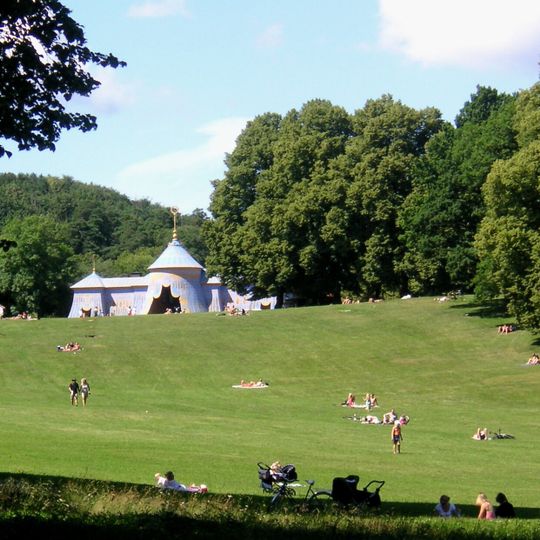
Hagaparkens pelouse is a broad open lawn in the English landscape style with gentle slopes and wide sight lines across the grounds. Paths circle the edges, passing mature trees and vegetation that frame and define the space.
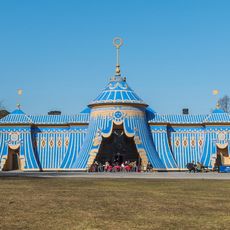
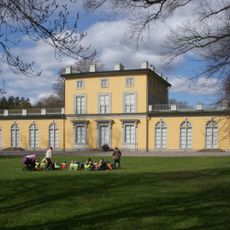
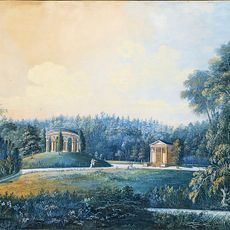
The lawn was laid out in the mid-1780s on plans by architect Fredrik Magnus Piper and finished in 1787, during Gustav III's reign. Piper framed it with curving gravel paths; the king overruled his clumps of trees along the eastern path in favour of a straight avenue, which still runs from the Koppartälten down to Gustav III's pavilion. Since 1994 the lawn has formed part of the Stockholm-Solna National City Park.
The name comes from French: "pelouse" means lawn, and the Swedish word "pelouse" was adopted for this grassy area. Since the park opened to the public in the 19th century, well-dressed Stockholm residents strolled around the lawn in spring and early summer. In July 1967 Parkteatern held its first "Bellman-fest" here, with picnics and song performances in the spirit of Carl Michael Bellman; the festival was repeated annually for over ten years.
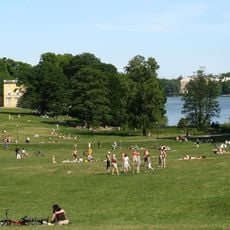
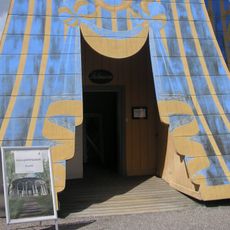
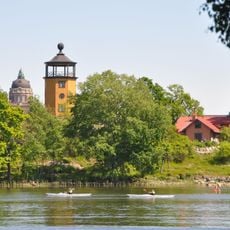
The lawn is bordered on all four sides by winding gravel paths, so you can circle it without crossing the grass. The slope runs down from the Copper Tents to Brunnsviken, with Gustav III's pavilion at the eastern end. In winter the slope is used for sledding and skiing.
In the early 1900s, sheep grazed on the lawn as a practical way to keep the grass trimmed without manual labor. Decades later the grounds became a venue for children's outings where refreshments were distributed during their visits.
The community of curious travelers
AroundUs brings together thousands of curated places, local tips, and hidden gems, enriched daily by 94,018 contributors worldwide.