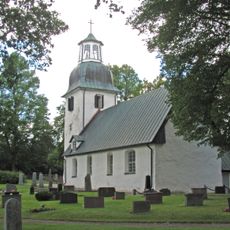
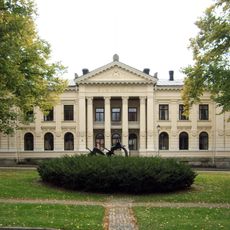
Kung Karls kyrka, Lutheran church in Kungsör, Sweden
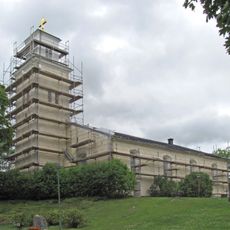
Kung Karls kyrka is an octagonal church with square cross-arms and a copper-covered dome, set on Kungsörs backe. Its walls are smooth rose-red cement plaster over a quarry-cut sandstone base, with gray surrounds; the west portal has a gray sandstone frame and wrought-iron and glass doors, and most windows have forged iron profiles and leaded glass.
King Charles XI commissioned architect Nicodemus Tessin the Younger to design the church, with construction occurring between 1690 and 1700. It was built as a royal commission reflecting the architectural importance of that era in Sweden.
The church is named after King Charles XI, who often stayed at the Kungsör royal estate and ordered the stone church in 1688. The pulpit came from the chapel of Tre Kronor Castle, and the altarpiece, drawn by Nicodemus Tessin the Younger, has a carved frame by Burchard Precht around David Klöcker Ehrenstrahl's 1692 painting of Christ on the cross.
The church stands on Kungsörs backe, the ridge above the town centre, and is reached on foot or by short car ride from the lower streets. The west portal, framed in carved grey sandstone with wrought-iron and glass doors, is the main entrance. The floor is level throughout the nave and cross-arms, and the choir occupies the eastern arm.
A large gilded copper crown was installed on the dome in 1897 to mark the 200th anniversary of King Charles XI's death. This gleaming crown remains visible from a distance and defines the church's appearance to this day.
The community of curious travelers
AroundUs brings together thousands of curated places, local tips, and hidden gems, enriched daily by 93,529 contributors worldwide.