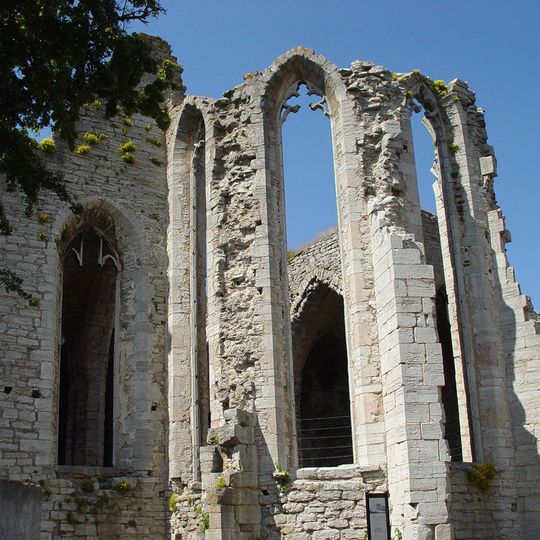
Saint Nicolaus church ruin in Visby, Church ruin in Visby, Sweden
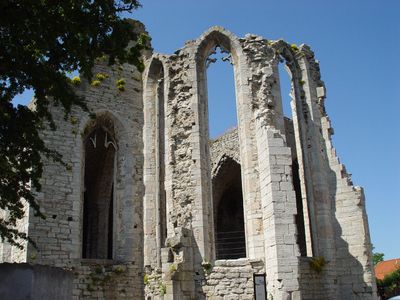
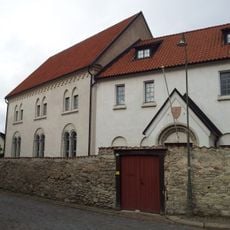
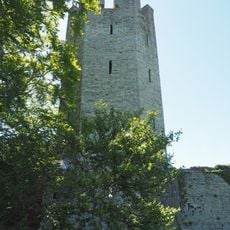
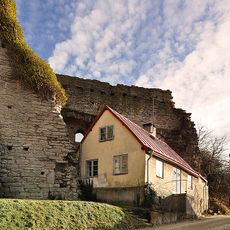
Sankt Nicolai kyrkoruin in Visby is a roofless medieval church ruin with a west gable dendrodated to 1251 and a Gothic choir added around 1400. Romanesque window openings remain in the walls, and a memorial plaque to prior Petrus de Dacia is mounted on the north side. Inside, rows of benches and a stage occupy the western part of the nave.
The first church on the site was built around 1215–1220 and named after St. Nicholas, patron saint of sailors. After a fire, Dominican friars took over the damaged church in 1228 and rebuilt it as a convent church; the present west gable dates to around 1251. The convent and church were burned by the town's defenders during the Lübeck attack in 1525, and after the Reformation the convent buildings were never rebuilt. In 1795 Mayor Peter Herman Grevesmühl allowed building material to be taken from the church.
The ruin has served as an open-air stage since 1929, when the musical play Petrus de Dacia premiered on 4 August with music by Friedrich Mehler and text by Josef Lundahl. It was performed almost every summer until 1990, except 1931 and 1940–1945, totalling about 753 performances. Recent concerts under the title Musik i ruinen have featured Viktoria Tolstoy, Malena Ernman and Marie Nilsson Lind.
The ruins are located at S:t Nikolaigatan 8 in central Visby and are easily accessible on foot from the town center. Access can be limited at times due to private events or concert preparations, so it is worth checking beforehand if visiting during peak summer months.
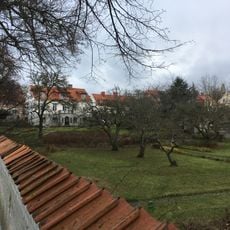
Inside the north wall of the ruin, narrow staircases are built into the masonry. On the north facade, traces remain of a two-storey building and a cloister walk that once ran along most of the wall. The convent buildings themselves stood north of the church and have left no visible remains above ground; their site is now a park.
The community of curious travelers
AroundUs brings together thousands of curated places, local tips, and hidden gems, enriched daily by 94,551 contributors worldwide.