Ängsholm, Manor house in Södertälje Municipality, Sweden
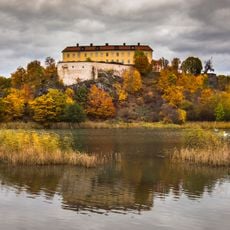
Ängsholm is a white manor house built in classical Swedish style, with symmetrical windows and a central entrance, located in Södertälje Municipality. Beyond the main building, the estate also holds a farm, a hotel, a marina, and a golf course on the same grounds.
Ängsholm belonged in the 14th century to the Bjälbo dynasty; the earliest documented owners were Magnus Ladulås's sons, dukes Erik and Valdemar. Later came the Örnfot, Ulv, Banér, Thott, Sture and Sparre families. In 1692 Karl XI reduced it to the crown and assigned it with Dåderö as residence for colonel Brändt of the Adelsfanan regiment. The main building burned in 1719 and again in 1912; Philip Wersén bought all five lots in 1914 and had a granite and Scanian brick castle built to Tore E:son Lindhberg's designs, inaugurated 1916. The Johansson family bought it on 1 April 1986.
The red cottage 150 metres from the main building, now called Villa Liljefors, is a 1700s wing that survived the Russian raids of 1719. The painter Bruno Liljefors lived there from 1901 to 1903 and drew inspiration from Mörkö's wildlife; he later built his Wig-Wam farm across the Ulvsundet strait.
The estate sits on the northern tip of Mörkö, called Dåderö, by the Näslandsfjärden inlet of Mörköviken. The red cottage, now called Villa Liljefors, stands about 150 metres from the main building. The grounds hold 53 hotel rooms and a beach studio with a wood-fired sauna, so the lakeside and the castle are separate stops.
The red cottage 150 metres from the manor, now called Villa Liljefors, is a 1700s wing that survived the Russian raids of 1719. The painter Bruno Liljefors lived there from 1901 to 1903, drawing on Mörkö's wildlife, and later built his Wig-Wam on the mainland across the Ulvsund.
The community of curious travelers
AroundUs brings together thousands of curated places, local tips, and hidden gems, enriched daily by 94,034 contributors worldwide.