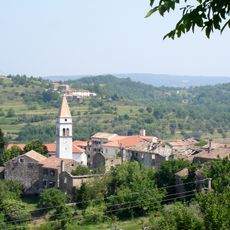
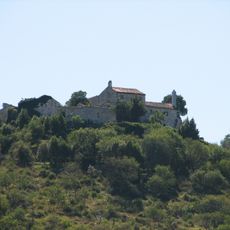
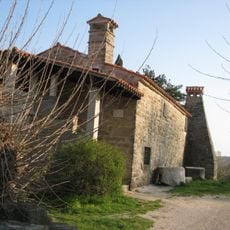
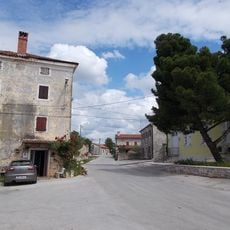
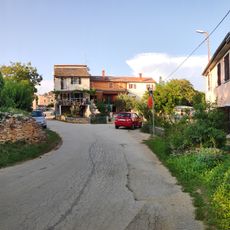
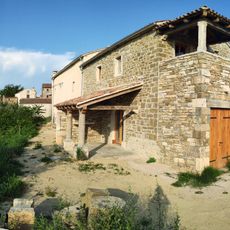
Krkavče Stone, Ancient megalith near Krkavče, Slovenia.
The Krkavče Stone is an unpolished stone megalith about 2.5 m tall, of which roughly 1.5 m rises above ground and nearly half is buried. Both faces carry a carved nude figure with outstretched arms and a sun halo around the head. The original is in the Regional Museum of Koper; a replica stands near the village of Krkavče in Slovenian Istria.
The sources date the menhir to the first centuries AD, not to the 2nd–1st century BCE. Its top is broken off, and during wartime the stone was buried and later re-erected nearby. The original now stands in the Regional Museum of Koper, while a replica marks the site near Krkavče.
Locals long treated the stone as a sun god. On St. Vitus's Day they laid hands on it; at Christmas an oak trunk burned beside it all night and villagers gathered at dawn to toast each other. The parish priest condemned this idolatry, so the rites were held in secret.
The site is reachable via marked walking trails from Krkavče village and can be visited throughout the year. The hilltop requires a moderate walk, so visitors should wear appropriate footwear and allow time for the journey.
Archaeologist Andrej Pleterski found that the stone stands at the centre of a Latin cross formed by four churches built around it; their bells were meant to weaken the devil's power in the stone, and all four can be heard from the spot.
The community of curious travelers
AroundUs brings together thousands of curated places, local tips, and hidden gems, enriched daily by 93,636 contributors worldwide.