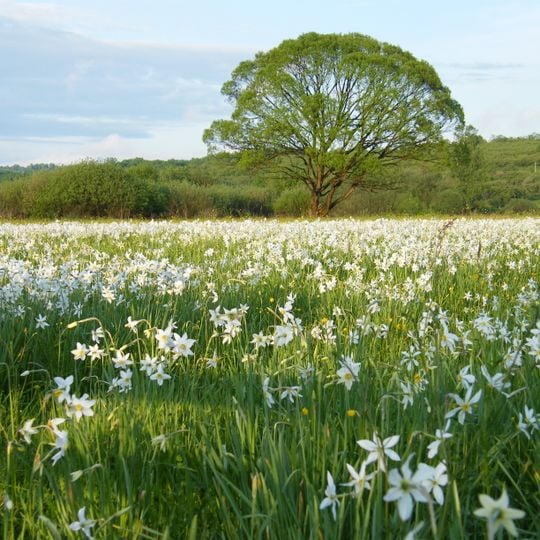
Valley of Narcissi, Nature reserve in Khust Raion, Ukraine.
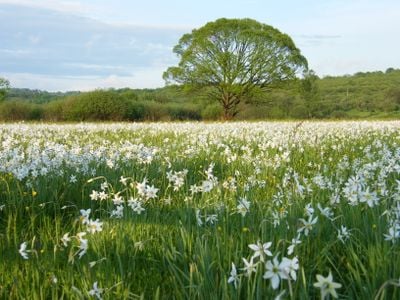
The Valley of Narcissi is a nature reserve located in lowland terrain of the Carpathian foothills at elevations between 180-200 meters. The site covers 256 hectares and provides habitat for alpine plants adapted to flourish in these lower elevations.
The valley's narcissi survived from the post-glacial period, when meltwater from the retreating ice favoured their spread on the lowland terrace of the Tisza. Under Austria-Hungary the Kireshi tract belonged to a forestry office and was guarded; after 1919 part was sold to Khust residents, who could graze livestock until St George's Day and farm again only from 14 October. In the 1980s drainage works destroyed 50 hectares of narcissi, ploughing stopped, and the area joined the Carpathian Biosphere Reserve in 1992.
The valley's name was given by Professor V. I. Komendar, who led efforts to preserve and restore the site. In the 1980s, drainage works destroyed 50 hectares of narcissi before ploughing was stopped and the area transferred to the Carpathian Biosphere Reserve. The mass bloom, in the second to early third decade of May, draws visitors from many places.
The best time to visit is from late April through early May, when thousands of wild daffodils blanket the meadows across the site. Plan to arrive early during this brief window to see the bloom at its peak.
The narcissus population here covers 85 hectares and survives on a flat river terrace, while the same species normally grows at 1,100–2,060 m in the Alps, Balkans and Carpathians. Professor V. I. Komendar, who gave the valley its name, led its protection after drainage works in the 1980s destroyed 50 hectares of flowers.
The community of curious travelers
AroundUs brings together thousands of curated places, local tips, and hidden gems, enriched daily by 93,889 contributors worldwide.