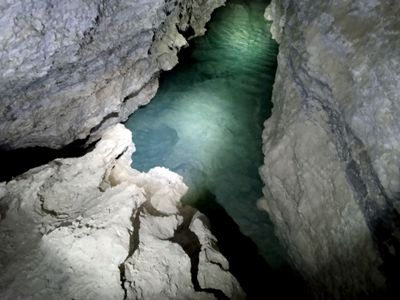
Priest's Grotto, Underground cave system in Ternopil Oblast, Ukraine.
Priest's Grotto, also called Ozerna or Blue Lakes Cave, is a gypsum cave near Strilkivtsi in Ternopil Oblast. Its explored passages total 142 km (2009), making it the 16th longest cave system in the world. The entrance lies at the bottom of an 18 m karst funnel; the first 15–20 m must be crawled through wet clay before dry, spacious corridors begin. The entrance gallery is about 100 m long, 15 m wide and up to 4 m high, and the cave is the only one in Podillia with underground lakes, the largest being the over 900 m² Hall of Mud.
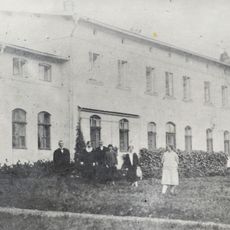
Local residents discovered Ozerna in the 1940s; it was declared a state nature monument in 1971. From 1942 to 1944, Jewish families hid first in nearby Verteba Cave, then moved to this lesser-known cave after the Germans found them. Thirty-eight people survived there until the Red Army liberated the area in April 1944, some without leaving the cave for 344 days.
The cave's Ukrainian name, Ozerna ("lake"), comes from the underground pools inside it, and its halls carry names such as Zal Sontsia (Hall of the Sun) and Zymova Kazka (Winter Tale). Survivors' accounts, recorded by the American caver Christos Nicola from 1993 onward, reached the public through National Geographic Adventure in 2004 and the 2013 documentary No Place on Earth.
The entrance lies 1 km from the south-western edge of Strilkivtsi, at the bottom of an 18 m karst funnel; the first 15–20 m must be crawled through wet clay before dry corridors begin. The cave floods periodically, when wide passages become lakes passable only by inflatable boat and some areas need scuba gear. Access is about 5.5 km south of Borshchiv.
One young survivor lost all recognition of natural light after spending months in complete darkness, finding even candlelight uncomfortable upon emergence.
The community of curious travelers
AroundUs brings together thousands of curated places, local tips, and hidden gems, enriched daily by 93,993 contributors worldwide.