Queen's House, Art museum in Greenwich Park, United Kingdom
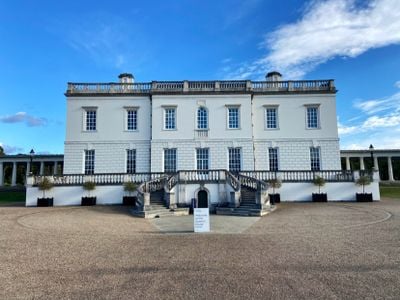
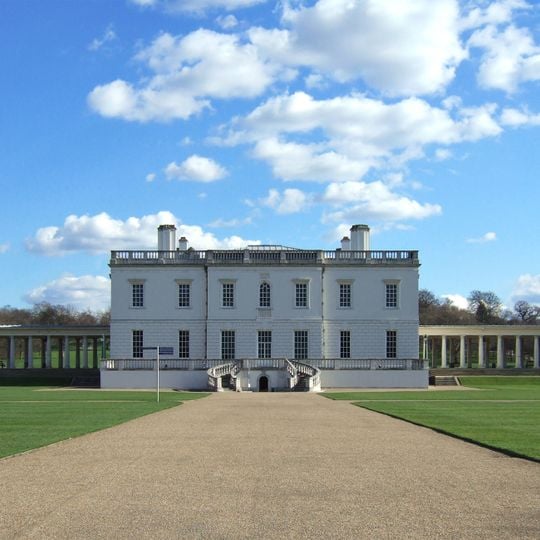
Queen's House is a white, two-storey former royal residence in Greenwich, built 1616–1635 to Inigo Jones's design. Its flat facade has evenly spaced rectangular windows, a round-headed window at the top centre and an arched opening below, with two short balustraded flights of steps flanking a recessed doorway. A stone balustrade tops the flat roof, tall white chimneys rise at the corners, and curving colonnades extend left and right at ground level.
James I commissioned architect Inigo Jones in 1616 to design the residence for Anne of Denmark, but construction was completed only after her death under Henrietta Maria. Jones brought Palladian architecture to England through this project and created a prototype for many later country houses.
The house takes its name from the queens who commissioned it: Anne of Denmark began it in 1616, and Henrietta Maria had Inigo Jones finish it in 1635. The Tulip Stairs' ironwork actually depicts lilies, a nod to Henrietta Maria's Bourbon family. The Great Hall has a marble floor by Nicholas Stone and a carved wooden ceiling.
The house sits at the centre of the Old Royal Naval College, aligned on a 35 m (115 ft) axis running down to the River Thames, so the view through the building frames the water. The Tulip Stairs lead from the cube-shaped Great Hall to the upper floor, where the queen's and king's bedrooms are; a further stair descends to the Orangery. The colonnaded wings added in 1807 by Daniel Asher Alexander flank the house east and west.
The central hall is laid out as a perfect square, with a curved spiral staircase that requires no central support. This technical achievement is considered one of the earliest examples of self-supporting construction in England.
The community of curious travelers
AroundUs brings together thousands of curated places, local tips, and hidden gems, enriched daily by 93,357 contributors worldwide.