Royal Observatory, Astronomical observatory in Greenwich, England
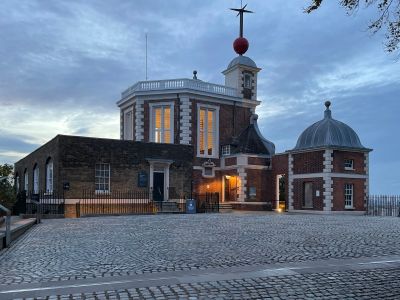
The Royal Observatory stands on a hill in Greenwich Park, its red brick Flamsteed House built with white stone quoins and topped by a white balustrade. A square tower rises above the roofline, banded in white and brick, carrying a grey dome with a red sphere and a metal weather vane. A lower brick wing to the right ends in a second grey dome with a small ball finial.
King Charles II commissioned the observatory in 1675, appointing Christopher Wren as architect and John Flamsteed as the first Astronomer Royal of England. The institution became a center for solving the longitude problem during the 18th century, which had hindered sailors for decades.
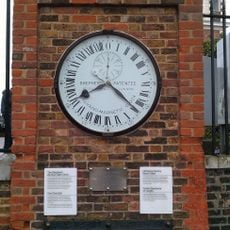
The Prime Meridian is marked in the courtyard by a brass strip, and since December 1999 a green laser has shone north across London's night sky along the line. The observatory gave its name to Greenwich Mean Time, the predecessor of Coordinated Universal Time. The time ball installed in 1833 still drops daily.
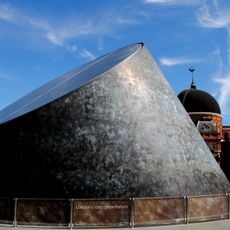
Entry covers access to the main buildings and outdoor areas, with advance booking advisable for planetarium sessions. The hill offers open views over London but can be steep, and pathways are not fully wheelchair-friendly everywhere.
The red time ball drops every day at 1:00 PM GMT from the tower, continuing a tradition that began in 1833 to help ships calibrate their chronometers. Captains watched the drop from a distance to synchronize their clocks with the exact time before sailing into open water.
The community of curious travelers
AroundUs brings together thousands of curated places, local tips, and hidden gems, enriched daily by 92,405 contributors worldwide.