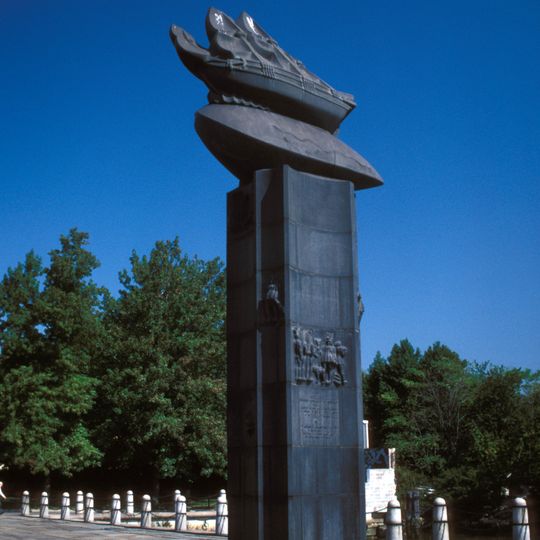
Fort Christina, Swedish colonial fort in Wilmington, United States.
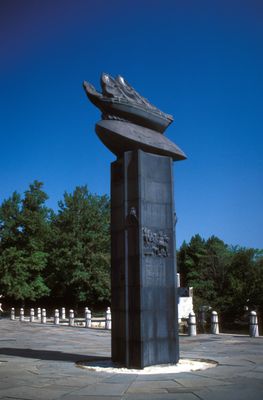
Fort Christina is a historic fortification site along the banks of the Christina River in Wilmington, Delaware. A granite monument and several commemorative plaques mark the spot where European settlers first came ashore nearly four centuries ago.
In 1638, Swedish and Finnish colonists arrived here and founded the first permanent European settlement in what is now Delaware. The site later passed into Dutch and then English hands as European powers competed for control of the coast.
The name honours Queen Christina of Sweden, after whom the 1638 settlement was named. The site is also known in Swedish as Fort Kristina or Hopokahacking. The monument unveiled in 1938 was a gift from the Swedish people, paid for by public subscription in which several hundred thousand Swedes took part, and it was designed by the Swedish sculptor Carl Milles.
The site lies about 1 mi (1.6 km) east of downtown Wilmington, at the confluence of the Brandywine and Christina rivers. The surviving feature is the stone outcropping called "The Rocks," which served as a natural wharf; nothing remains of the fort itself. The Carl Milles monument, topped by a replica of the Kalmar Nyckel, stands in the park.
The ships Kalmar Nyckel and Fogel Grip brought fewer than 30 people here in total, many of whom were Finnish. A replica of the Kalmar Nyckel docks regularly at the nearby harbor today.
The community of curious travelers
AroundUs brings together thousands of curated places, local tips, and hidden gems, enriched daily by 94,667 contributors worldwide.