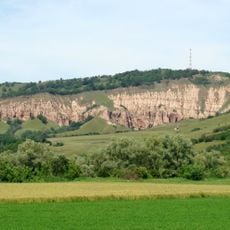
Căpâlna Fortress, Dacian fortress near Săsciori, Romania
Căpâlna Fortress is a Dacian stronghold built with stone and wooden structures on a hilltop near Săsciori, defended by walls and towers that still stand among the ruins. The site spreads across multiple leveled terraces climbing the slope, designed to maximize defensive positions and shelter within the mountainous terrain.
Built in the second half of the 1st century BC, the fortress guarded the Sebeș Valley route to Sarmizegetusa Regia. It was occupied by the Romans during Trajan's First Dacian War, and its second gate was blocked after 102 AD. The Romans burnt and destroyed it around 106 AD.
The fortress guarded the Sebeș Valley route to Sarmizegetusa Regia, about 40 km west. Excavations found clay T-shaped moulds for shaping pottery, spindle whorls for spinning wool, and pottery-wall tokens probably used in games played by the garrison. A tower house stood by the main gate.
From the DN67C at the bottom of the valley, a sign near the bridge in Căpâlna marks the route; the fortress is reached by walking about 2 km up a steep gravel road. The hill slopes are abrupt, so allow time for the climb.
Among the finds were clay T-shaped moulds for shaping pottery and "tokens" cut from vessel walls, probably used for games in the garrison. Twenty-nine Roman silver coins were recovered inside and around the tower house. A gold necklace with pendants and two gold earrings came to light around 2002-2003.
The community of curious travelers
AroundUs brings together thousands of curated places, local tips, and hidden gems, enriched daily by 93,683 contributors worldwide.