Hermitage of St. Peter Koriški, Cave hermitage and monastery ruin in Korishë, Prizren municipality, Kosovo
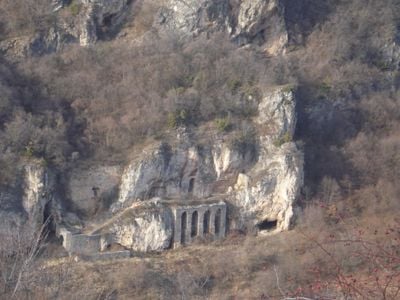
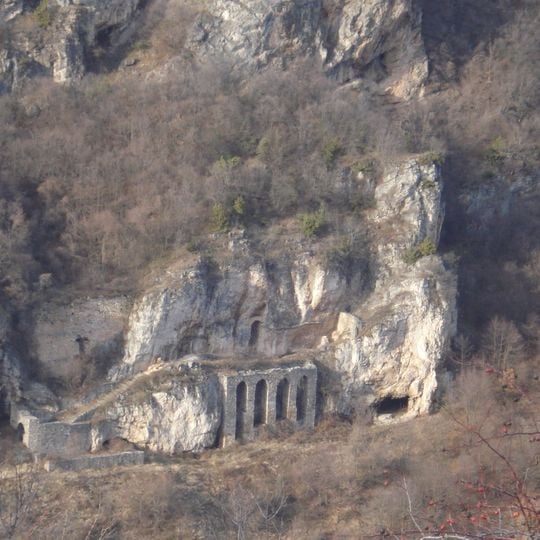
The Hermitage of St. Peter Koriški is a rock-cut cave church and monastery ruin set into a pale grey cliff above the Koriša river, about 20 km from Prizren. Its lower wall holds four tall, narrow, round-arched openings with dark interiors; above and to the right, a single rectangular opening is cut into the rock. The cave, a natural hollow slightly worked into a church, preserves a few square metres of frescoes from the saint's lifetime, among the oldest examples of monumental painting in medieval Serbia.
The cave church existed by the reign of King Milutin, who donated it to Hilandar, and it is named in Tsar Dušan's charter of 9 May 1343, when Elder Grigorije gave it with its estate and library. A church was added alongside in the 14th century and painted in 1350. The monastery survived until 1760, when Sultan Mustafa III's firman transferred its remaining lands to St. Mark's Monastery.
The site is named after Peter of Koriša, a 13th-century hermit who lived in the cave until his death; his cult was strong enough that Tsar Dušan came here to venerate his relics between 1346 and 1355. The medieval village was called Sveti Petar, a name kept in Turkish documents until 1876, when the Albanian name Kabaš prevailed, recalling a homeland in northern Albania. A few square metres of frescoes painted during Peter's lifetime survive in the cave.
The site lies 7–8 km up the Koriša river below Mount Rusenica, about 20 km from Prizren, in the village of Korishë. The ruins stand in a gorge above the village, reached on foot; paths are unmarked and the ground uneven. The cave church and church remains were damaged by unauthorised construction works reported in 2025, so check locally before setting out.
The oldest part is the hermitage itself: a natural hollow in the cliff, only slightly worked, turned into a chapel. A few square metres of frescoes painted during Peter of Koriša's lifetime survive there, counted among the earliest examples of monumental painting in medieval Serbia. His tomb lay at the back of the cave.
The community of curious travelers
AroundUs brings together thousands of curated places, local tips, and hidden gems, enriched daily by 94,572 contributors worldwide.