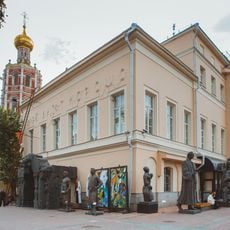
Vysokopetrovsky Monastery, Orthodox monastery in Tverskoy District, Russia
Vysokopetrovsky Monastery is an Orthodox monastery in the Tverskoy District consisting of multiple religious buildings positioned on a hill above Petrovka Street in central Moscow. The complex combines structures from different periods and architectural styles into a unified ensemble.
The monastery is believed to have been founded in the 1320s by Saint Peter of Moscow, the first Russian metropolitan to have his see in Moscow. The katholikon dedicated to Saint Peter was long dated to 1692, but studies in the 1970s showed it was built in 1514–1517 by Aloisio the New. In the late 17th century the Naryshkin boyars, relatives of Peter the Great, made it their family burial place and rebuilt it in the Naryshkin Baroque style. Closed by the Soviet authorities in 1929, it was returned to the Russian Orthodox Church in 1992.
The monastery functions as an active Russian Orthodox Church center and houses the Moscow Literature Museum since 2005 in its buildings. Visitors experience both religious spaces and cultural exhibitions within the same complex.
The monastery stands at the corner of Petrovka Street and Petrovsky Boulevard, house 28, on a hill from which Petrovka descends toward the Kremlin. The grounds are shared by the Russian Orthodox Church and the Moscow Literature Museum, so some buildings are open for worship and others for exhibitions. Enter from Petrovka; the gate churches and belltower mark the main approach.
For decades, Saint Peter's Cathedral was dated to 1692 and treated as a monument of the Naryshkin Baroque. Excavations and written-source studies in the 1970s proved it was built in 1514–1517 by Aloisio the New, and restorer Boris Dedushenko also found traces of a 14th–15th-century wooden church on the site.
The community of curious travelers
AroundUs brings together thousands of curated places, local tips, and hidden gems, enriched daily by 94,524 contributors worldwide.