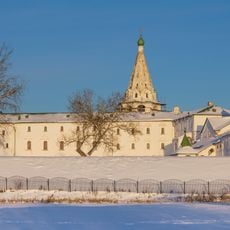
Cathedral of the Nativity in Suzdal, 13th-century Orthodox Cathedral in Suzdal, Russia
The Cathedral of the Nativity of the Theotokos stands inside the Suzdal Kremlin, within a ring of earthen ramparts in a bend of the Kamenka River. Its lower walls are 13th-century white stone, rebuilt in 1528–1530 above the arcade frieze with female masks in brick and crowned with five domes. Inside are wall paintings of the 13th, 15th and 17th centuries.
A first cathedral was built around 1102 under Vladimir Monomakh. In 1222 Yuri Vsevolodovich had the dilapidated building demolished and replaced within three years by a white-stone church; the Mongols sacked Suzdal in 1238 and the upper part collapsed after the 1445 fire. In 1528 Bishop Gennady obtained permission from Vasili III to rebuild, keeping the old walls up to the arcaded frieze and completing the brick upper structure with five domes by 1530.
The interior walls display religious frescoes from three different periods of Russian Orthodox artistic tradition. These paintings from the 13th, 15th, and 17th centuries show how the way people painted sacred images changed over time.
The building functions as both an active Orthodox church with regular services and an exhibition space under joint management. Visitors should know that different areas may be accessible depending on service times.
The west and south doors are wooden cores sheathed in copper sheets decorated by fire gilding, a technique the sources call "ognevoye zolocheniye". The west doors show scenes from the life of Christ and partly of the Virgin, while the south doors depict the deeds of angels, especially the Archangel Michael. They date from the first third of the 13th century.
The community of curious travelers
AroundUs brings together thousands of curated places, local tips, and hidden gems, enriched daily by 94,263 contributors worldwide.