Bogolyubsky Monastery, Orthodox monastery in Bogolyubovo, Russia
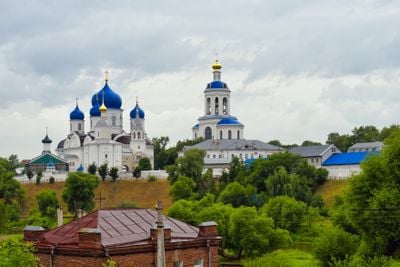
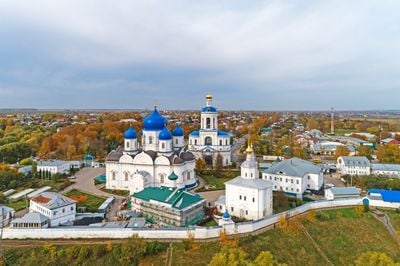
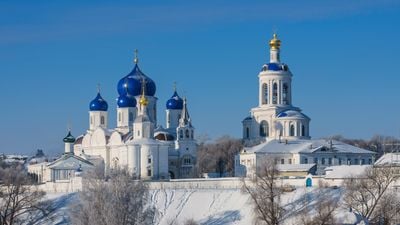
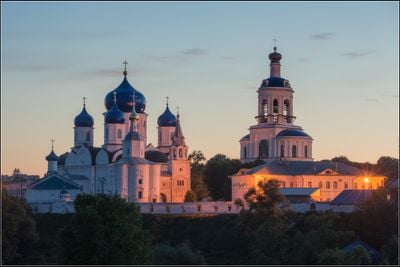
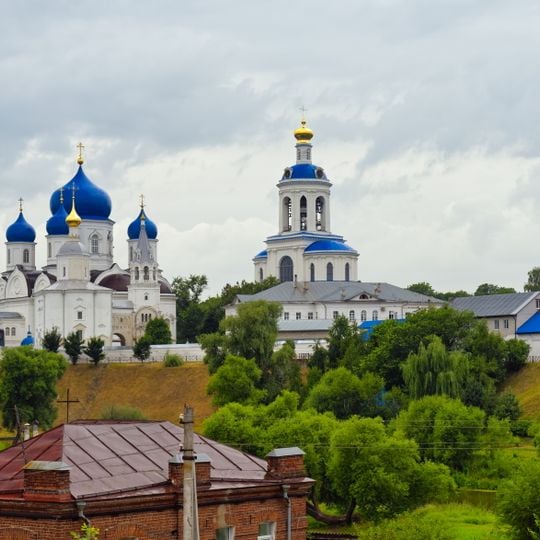
Bogolyubsky Monastery is a walled complex on the site of Prince Andrei Bogolyubsky's 12th-century palace. Its white stone buildings with blue onion domes include the 1751–1758 Nativity Church, the 1855–1866 cathedral by Konstantin Ton, and a bell tower over the surviving medieval staircase tower. A low white wall with a red-brown roof encloses the grounds.
Prince Andrei Bogolyubsky founded a country residence here around 1158, with a stone church of the Nativity of the Virgin. Andrei was murdered in the castle in 1174; the monastery was probably founded by his successors in the early 13th century to atone for the crime. The white-stone church collapsed in 1722 and was rebuilt in 1751–1758. The monastery was closed in 1923 and monastic life resumed in 1991.
Since the 18th century a cross procession has carried the Bogolyubskaya Icon of the Mother of God from Vladimir to the monastery every 1 July, in memory of a plague that ended after prayers before the image. The monastery keeps sewing, icon-painting and carpentry workshops, and its bells weigh 1,050, 2,500 and 8,000 kg. A chapel and two bathing pools stand at the holy spring by the walls.
The monastery sits close to the M7 highway and is easily accessible from the Vladimir Region, with regular religious services welcoming visitors. Plan to navigate uneven grounds and traditional structures that form part of the historical complex.
The site preserves rare fragments of a 12th-century princely residence, representing the only surviving example of civil architecture from that era in Russia. These stone remains offer a rare glimpse into the daily life and living spaces of medieval nobility.
The community of curious travelers
AroundUs brings together thousands of curated places, local tips, and hidden gems, enriched daily by 93,136 contributors worldwide.