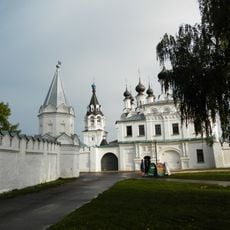
Resurrection monastery in Murom, Orthodox monastery in Murom, Russia
The Resurrection Monastery in Murom is an Orthodox monastery and federal cultural heritage site set on a high bank of the Oka River. It comprises several stone churches and auxiliary buildings enclosed within a walled compound.
A local legend traces the convent to the 13th century and to Princes Peter and Fevronia of Murom, said to have blessed the hill; the Resurrection Church is first documented in 1566, and in 1616 Poles of Lisowski's detachment killed its priest Ioann. The 1637 inventory describes a wooden church on a lower storey with three tents, two side chapels, 13 icons and 25 books. Merchant Abraham Cherkasov, enriched in the grain and salt trade, built the brick churches between 1646 and 1678. Catherine II's secularisation closed the convent in 1764, and the churches became parish churches until Soviet times.
The monastery's name comes from the Resurrection Church, whose five domes and refectory gallery date from between 1646 and 1678, built with money from the Murom merchant family Cherkasov, who grew rich on grain and salt. The gate church of the Entry into the Temple, with its single dome and tented bell tower, was the heated one, used in winter. The names of the architects are not recorded.
The monastery is located on Iulsky Lane 1A and is open every day of the week. The site sits on a slope, so sturdy footwear is a good idea since moving between the buildings involves some uneven ground.
The monastery was closed in the Soviet years, its valuables moved to a museum and the buildings turned into warehouses. In 1929 the cemetery was destroyed, and in 1950 a football pitch was laid over the graves. From the 1970s to the 1980s the Resurrection Church housed a boxing ring.
The community of curious travelers
AroundUs brings together thousands of curated places, local tips, and hidden gems, enriched daily by 94,327 contributors worldwide.