Fortress of Izborsk, Medieval fortress in Izborsk, Russia.
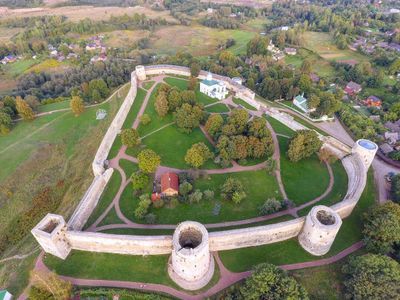
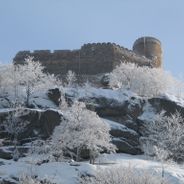
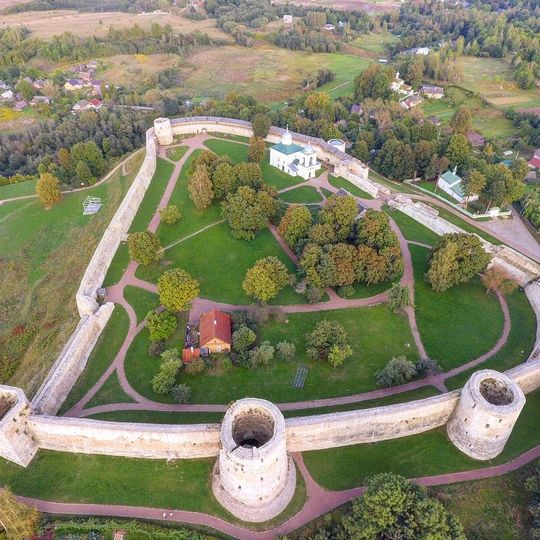
The Fortress of Izborsk stands on Zheravya Hill, its walls of limestone laid in the early 15th century and thickened in the 16th to as much as 5 m on the attack side. The plan forms an irregular triangle with rounded corners, about 850 m of walls enclosing some 2.4 hectares, with six conical towers spaced no more than 60 m apart. The northwest Talavskaya Tower is the only rectangular one, 8.5 by 9.5 m and about 15 m high, with five tiers of embrasures.
The fortress was founded in 1330 under Pskov rule as a response to external military threats from neighboring powers. Over time it was rebuilt and reinforced several times as defense strategies and weapons changed.
The fortress's name comes from the town it guards, and its towers carry folk names: Lukovka, Ploskushka, Vyshka, Ryabinovka, Temnushka and Kolokolnaya. The Kolokolnaya tower kept a bell frame until the 1870s. Near the walls stands the 1931 Chapel of the Korsun Icon of the Mother of God, designed by architect Alexander Vladovsky.
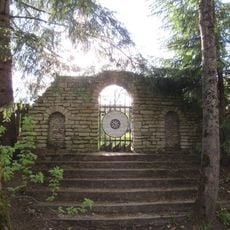
The fortress stands about 1.5 km from the old Truvor settlement site, on Zheravya Hill. The walls enclose roughly 15,000 m², with towers no more than 60 m apart, so the whole circuit can be walked on foot. The Nikolsky Gate is the surviving inner gate of the Nikolsky zahab, a narrow walled passage about 4 m wide and 36 m long.
The Lukovka tower, the oldest in the fortress, originally stood on the cape as the easternmost tower; after the walls were extended it ended up inside the perimeter and its lower loopholes were walled up. A 40-metre underground corridor once linked the fortress to the foot of the cape.
The community of curious travelers
AroundUs brings together thousands of curated places, local tips, and hidden gems, enriched daily by 94,018 contributors worldwide.