Alexander Nevsky Bridge, Road bridge in Veliky Novgorod, Russia
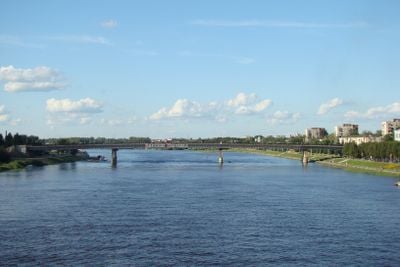
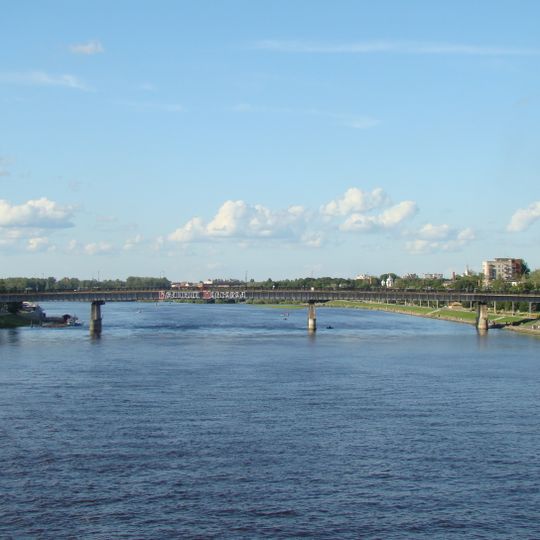
The Alexander Nevsky Bridge crosses the Volkhov River on three spans supported by concrete abutments, linking the Sofia and Trade sides at Rozvazha Street and Fyodorovsky Ruchey. Its roadway is 12 metres wide, with 2.3-metre sidewalks on each side, and the total length is 279.36 metres. The architect V. Pavlushkov designed the structure.
Construction began in February 1945 with a temporary wooden structure built to reconnect the city after World War Two. The permanent concrete bridge was completed in November 1954, representing the Soviet reconstruction effort in the post-war period.
The bridge bears the name of Prince Alexander Nevsky, a medieval Russian ruler who defended Novgorod lands from foreign invasion in the 13th century. This historical connection makes it a symbol of local identity for the people who live here.
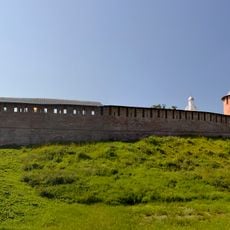
The bridge links the Sofia side at Rozvazha Street with the Trade side at Fyodorovsky Ruchey, where one of Novgorod's two pedestrian underpasses sits at the junction with Bolshaya Moskovskaya Street. The roadway is 12 m wide with 2.3 m sidewalks on each side. The Novgorod Kremlin and Yaroslav's Court stand close to either end.
The bridge has three spans on concrete abutments, not four sections or two pillars; architect V. Pavlushkov designed it, and a state commission accepted it on 16 November 1954 with a grade of "excellent". It stands where Fyodorovsky Ruchey stream was filled in and paved over as a street in 1952.
The community of curious travelers
AroundUs brings together thousands of curated places, local tips, and hidden gems, enriched daily by 93,896 contributors worldwide.