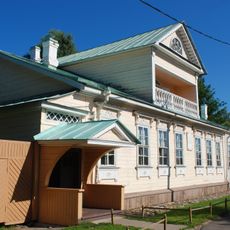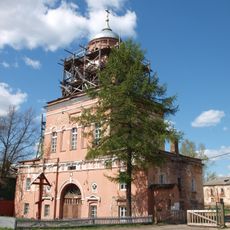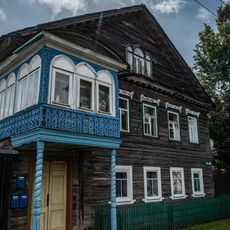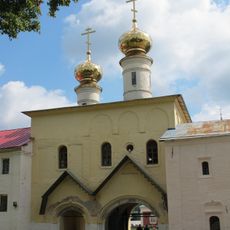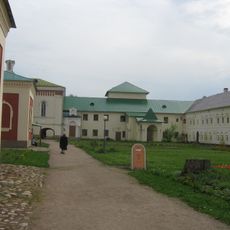
Tikhvin Assumption Monastery, Orthodox monastery in Tikhvin, Russia
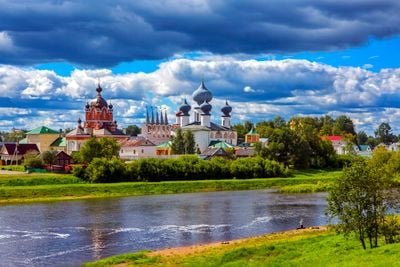
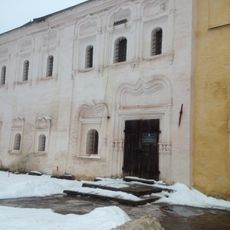
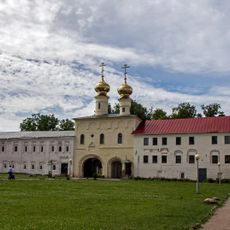
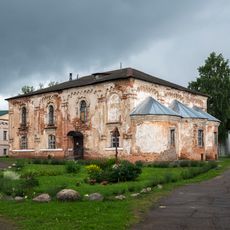
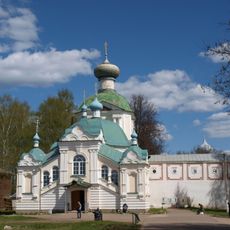
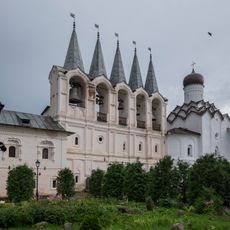
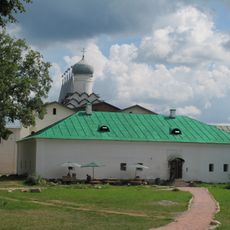
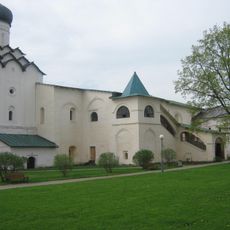
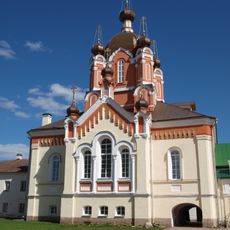
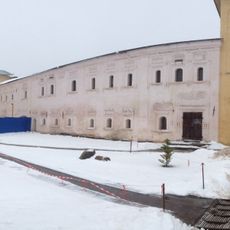
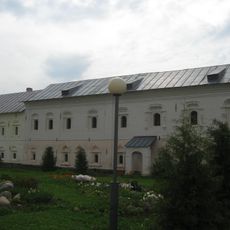
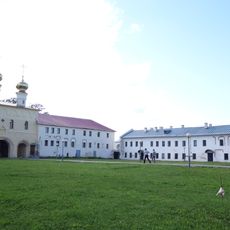
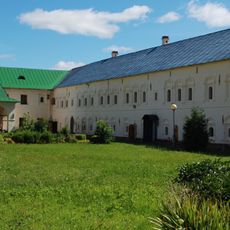
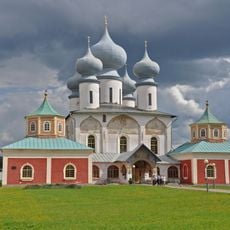
The Tikhvin Assumption Monastery is a walled complex on the left bank of the Tikhvinka River. Its oldest building is the five-domed Assumption Cathedral, built of stone between 1507 and 1515 with six pillars, three apses and covered galleries on three sides. The refectory church dates from 1581, the belfry from 1600, and the cells from the late 17th century.
Founded by decree of Ivan the Terrible on 10 February 1560, the monastery was built as a fortress near the Swedish border under the supervision of Fyodor Syrkov. In 1613 its defenders under Prince Semyon Prozorovsky withstood a siege by Jacob De la Gardie's Swedish army until reinforcements arrived. Closed in the 1930s, it was returned to the Russian Orthodox Church in 1995.
The monastery's main relic is the Tikhvin Icon of the Mother of God (Hodegetria), believed to have appeared in 1383. A legend tells that during a plague in Staraya Russa and Tikhvin, the icons were swapped and the epidemic ceased. The icon was taken abroad in 1944 and kept in Chicago until its return in 2004.
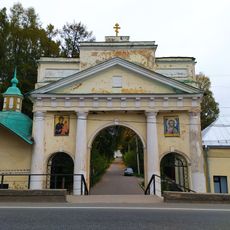
The monastery stands on the left bank of the Tikhvinka River, and its rectangular wall with towers can be walked around from outside. The main entrance and the oldest buildings, including the 1507–1515 katholikon, lie inside the walls. The belfry, built in 1600, is a useful landmark for orientation.
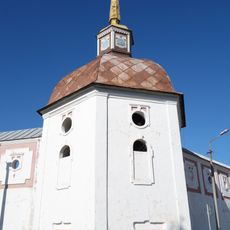
The monastery's walls, begun in 1766 under Empress Elizabeth's decree, were finished in 1795 with donations from Paul I and Alexander I plus about 20,000 roubles of the monastery's own funds, reaching roughly 450 sazhens in length. The Omutnaya and Taynichnaya towers, lost after the war, were rebuilt after 2004.
The community of curious travelers
AroundUs brings together thousands of curated places, local tips, and hidden gems, enriched daily by 93,343 contributors worldwide.