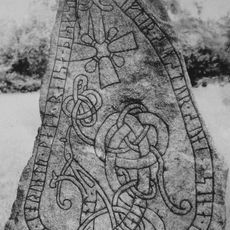
Uppland Runic Inscription 871, Norse runestone at Open-air museum Skansen, Stockholm, Sweden
Uppland Runic Inscription 871 features intricately carved runes and animal-shaped decorative patterns in the Urnes style, a refined artistic technique of the Viking period. The stone displays the skillful craftsmanship of its carver through detailed line work and balanced composition.
The stone stood by a road between Ölsta and Säva, part of the Eriksgata, until 1896. That year it was sold for 50 kronor to Artur Hazelius, founder of Skansen and the Nordic Museum, and moved to the open-air museum on Djurgården, which had opened in 1891. Local tradition holds that the sale angered villagers who considered the stone common property.
The inscription lists the names of people who commissioned the stone to honor a deceased relative, reflecting how Norse communities preserved memory through carved memorials. Such stones served as public records of kinship and loss within Viking society.
The stone stands on the Skansen open-air museum grounds on Djurgården, where it has been since 1896. The 1991 protective paint was an experiment by the Swedish Rune Authority to test how long it shields the stone from moss and weather; it is expected to last about fifty years. The stone is 1.84 m high and 1.3 m wide, so look for it among the museum's assembled historic buildings rather than in a rune park.
In 1991 the Swedish Rune Authority painted the stone with a protective color as an experiment to see how long it would guard against moss and weather; the treatment is expected to protect it for about fifty years. The stone was sold in 1896 for 50 kronor to Artur Hazelius, founder of Skansen, and the sale angered locals who considered it village property.
The community of curious travelers
AroundUs brings together thousands of curated places, local tips, and hidden gems, enriched daily by 94,958 contributors worldwide.