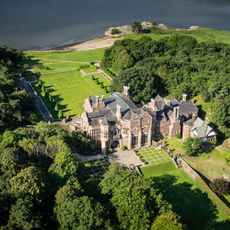
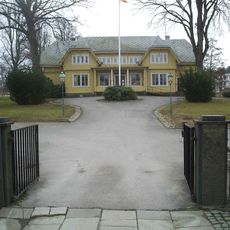
Gåsevadholm Castle, Castle on an island in Rolfsån river, Kungsbacka Municipality, Sweden.
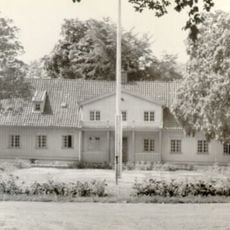
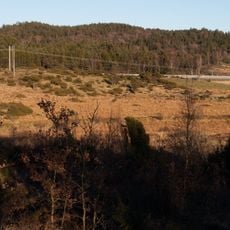
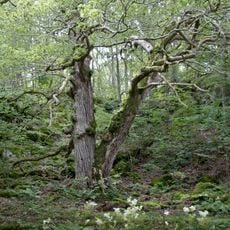
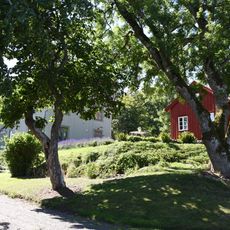
Gåsevadholm is a castle on an island in the Rolfsån river, distinguished by its pink facade and 18th-century architectural style. The building sits within a landscape of gardens and natural areas that together form a historical estate complex.
Merchant and East India Company director Niclas Sahlgren built the castle in 1757, yet the lands trace back to the 14th century Pik family. This extended history made the location a continuously evolving possession across several eras.
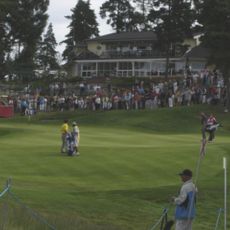
The name Gåsevadholm records a ford (vad) over the Rolfsån, with -holm added once the castle was ringed by water and stood on an islet. Since 2001 the estate's roughly 220 hectares of farmland have been leased out; today the most visible activities are the stables and Forsgården golf club, which rents about 60 hectares.
Gåsevadholm is a private estate and the castle is not open to visitors; the park and grounds should not be entered without permission. The most visible activity on the lands today is the Forsgården golf club, which leases about 60 hectares of the property, alongside stables. The estate lies in Tölö parish, Kungsbacka Municipality, and is best seen from the public road.
The botanical garden and natural history museum were created not by Carl Otto Silfverschiöld but by Claes Alströmer, a Linnaeus pupil who married Sara Katarina Sahlgren and died at Gåsevadholm in 1794. Carl Otto Silfverschiöld instead rebuilt the castle in 1855–1856 to designs by architect Adolf Wilhelm Edelsvärd, in a style imitating medieval architecture.
The community of curious travelers
AroundUs brings together thousands of curated places, local tips, and hidden gems, enriched daily by 93,900 contributors worldwide.